

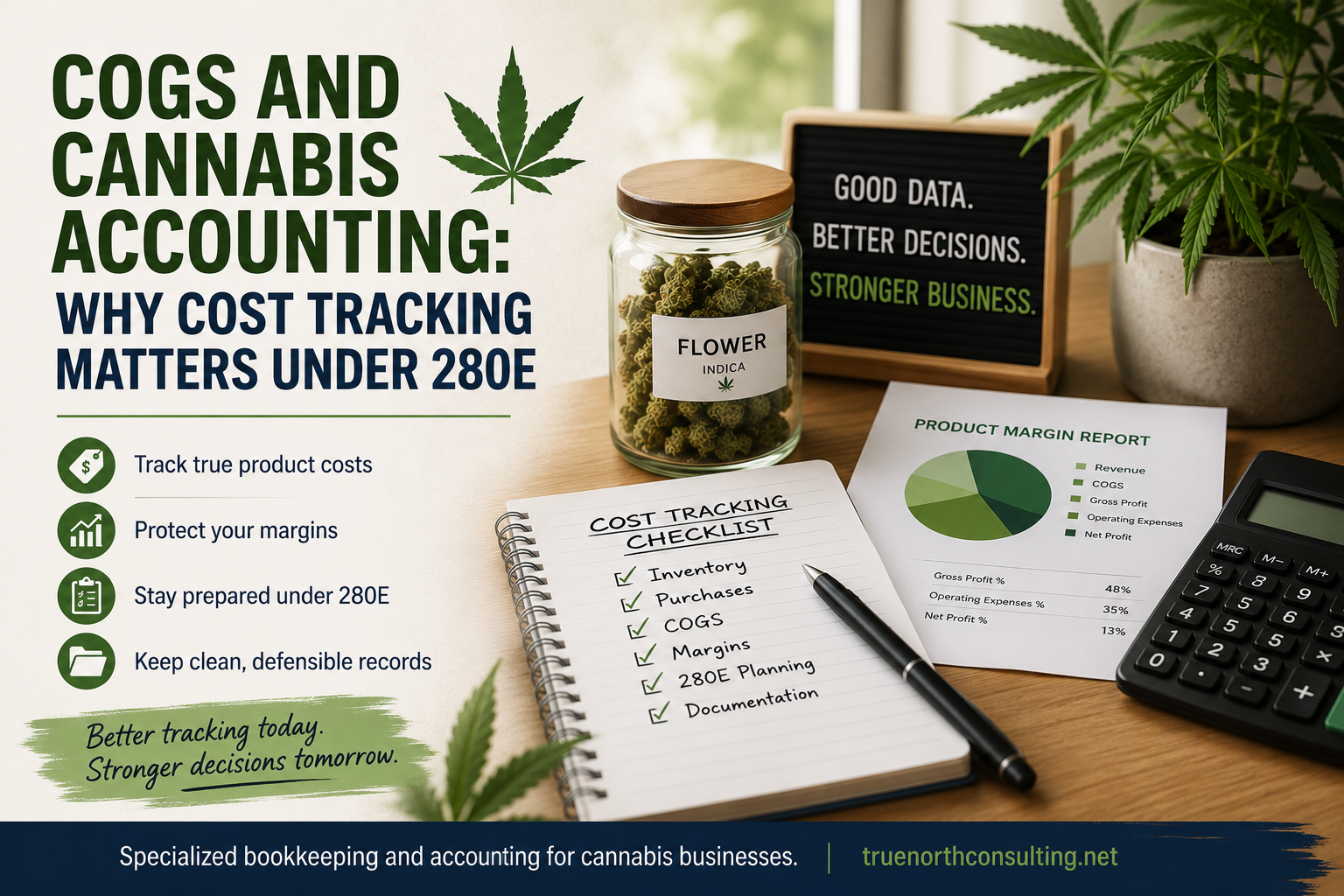
COGS and Cannabis Accounting: Why Cost Tracking Matters Under 280E
Cost Tracking
A cannabis operator can look at a busy sales day and feel good.
The shelves are moving. Customers are coming back. The POS report looks strong. The team is busy, the store is active, and revenue is flowing through the business.
But in cannabis, a sale does not tell the whole story.
A product may sell well and still leave less profit than expected. A promotion may bring in traffic but quietly weaken margins. A vendor deal may look attractive until freight, packaging, discounts, shrinkage, and slow moving inventory are considered. By the time tax planning comes around, the question is no longer just, “How much did we sell?”
The better question is, “What did it really cost us to make that sale?”
That is where COGS becomes one of the most important parts of cannabis accounting.
Every product has a financial story
In a cannabis business, every product on the shelf carries a story. There is the price the customer sees. There is the cost the business paid to bring that product in. There are direct costs tied to inventory, product movement, packaging, freight, production, or purchasing depending on how the business operates. Then there is the tax story, where 280E can make normal operating expenses much harder to handle.
When cost tracking is weak, those stories get mixed together.
The owner may know that flower is selling, but not whether the margin is strong. Edibles may move quickly, but the actual profit may be lower than expected. Pre rolls may look like a great category, but discounts or labour time may be quietly reducing the return. Inventory may look full, while cash is tied up in products that are not moving fast enough.
That is why COGS is not just a tax category. It is a way of understanding what the business is really earning from the products it sells.
Strong sales can create false confidence
Revenue can be misleading when product costs are not tracked carefully.
A cannabis business may have a strong month in sales and still feel pressure when it is time to pay vendors, payroll, rent, taxes, security, software, and other costs. The owner may wonder why the business feels tight when the sales report looks healthy.
Often, the answer is hiding in the cost structure.
Maybe the business is discounting too heavily. Maybe vendor costs increased, but pricing did not adjust. Maybe inventory is being purchased faster than it is being sold. Maybe certain categories are taking up shelf space but not producing enough profit. Maybe the books are not clearly separating product costs from operating expenses.
Without good cost tracking, the owner sees movement but not necessarily margin.
That is a dangerous place to run from.
280E makes the details matter more
Section 280E is one of the reasons cannabis operators cannot treat accounting like a normal retail business. For businesses still subject to 280E, many ordinary business expenses may not be deductible federally in the same way they would be for other industries.
That makes COGS especially important.
COGS is connected to the cost of the products sold. When it is tracked properly, it helps the business understand gross profit, margins, inventory movement, and tax planning exposure. When it is tracked poorly, the business may not have a reliable view of what is actually happening.
The key is support.
COGS should not be guessed at year-end. It should not be built from memory, rough estimates, or incomplete vendor records. It should be supported by invoices, inventory records, sales reports, reconciliations, and a chart of accounts that gives the business enough detail to understand its own numbers.
In cannabis, the details are not small. They are where the tax and margin story lives.
Inventory is usually where the trouble starts
Many cost tracking problems begin with inventory.
A product comes in, but the invoice is not attached or saved properly. A discount is offered, but the effect on margin is not reviewed. Product categories are too broad. Inventory counts do not match the system. Shrinkage is not clearly tracked. A vendor cost changes, but the pricing strategy stays the same.
Individually, these may feel like small issues. Together, they can distort the financial picture.
If inventory is wrong, COGS may be wrong. If COGS is wrong, gross profit may be wrong. If gross profit is wrong, the owner may be making pricing, purchasing, and tax planning decisions using numbers that are not reliable.
That is how a business can be busy and still feel financially unclear.
COGS helps owners make better decisions
Good cost tracking gives cannabis operators better control.
It helps answer practical questions that matter every week, not just at tax time. Which products are actually profitable? Which categories deserve more shelf space? Are vendor costs rising? Are discounts helping or hurting? Is inventory tying up too much cash? Are we setting prices based on real numbers or habit?
When the owner has those answers, the business becomes easier to manage. Pricing becomes more intentional. Purchasing becomes smarter. Inventory decisions become cleaner. Cash flow becomes easier to understand. Tax planning conversations become more productive because the accounting records are not being reconstructed at the last minute.
That is the point of good cannabis accounting. It should help the operator see the business clearly enough to make better decisions before problems become expensive.
Do not wait for tax season to clean up COGS
Waiting until tax season to review COGS is risky.
By then, the business may be trying to piece together a full year of activity from vendor invoices, inventory reports, POS exports, bank transactions, receipts, and memory. That creates stress for the owner and limits the value of the accounting work.
COGS should be reviewed throughout the year. Inventory should be monitored regularly. Vendor bills should be saved and categorized correctly. Product costs should connect to the accounting system. Reports should be reviewed monthly so issues can be corrected while the information is still fresh.
The goal is not just to prepare a tax return.
The goal is to run the business with better information.
Changing rules do not remove the need for clean books
There has been continued movement in the U.S. cannabis tax and regulatory conversation, and operators should keep paying attention. But even when rules are changing, clean records remain essential.
If tax guidance changes, businesses with organized books will be in a stronger position to understand what applies to them. They will be better able to review product lines, separate activity where needed, analyze costs, and support the way numbers are reported.
Businesses with messy records may have a harder time figuring out what changed, what did not, and how to respond.
That is why the best move is not to wait for the rules to become perfect. The best move is to make the books stronger now.
How True North Consulting can help
Cannabis operators need accounting support that understands the connection between COGS, inventory, 280E, margins, documentation, and cash flow.
At True North Consulting, we help cannabis businesses build cleaner bookkeeping systems, improve cost tracking, organize records, review margins, and create stronger financial visibility. We understand that cannabis accounting is not just about recording transactions. It is about helping owners protect the business with numbers that are clear, useful, and well supported.
True North Consulting is also part of the Dope CFO professional network, giving us access to cannabis specific accounting frameworks and industry focused support for businesses operating in this space.
If your cannabis business is selling product but you are not fully confident in your COGS, inventory records, margins, or tax planning process, True North Consulting can help you take a closer look and build a stronger financial foundation.
Final thought
In cannabis, the sale is only the beginning of the story.
The real question is what the business keeps after the cost of that product is understood, recorded, and supported properly. Poor cost tracking can create unclear margins, cash flow pressure, tax planning stress, and weak financial reports. Strong cost tracking gives the owner better visibility and more control.
Cannabis operators already carry enough pressure. Their accounting should make the business clearer, not harder to understand.
With clean COGS tracking, regular reviews, and the right financial partner, the numbers can become a tool for better decisions instead of a source of stress.