


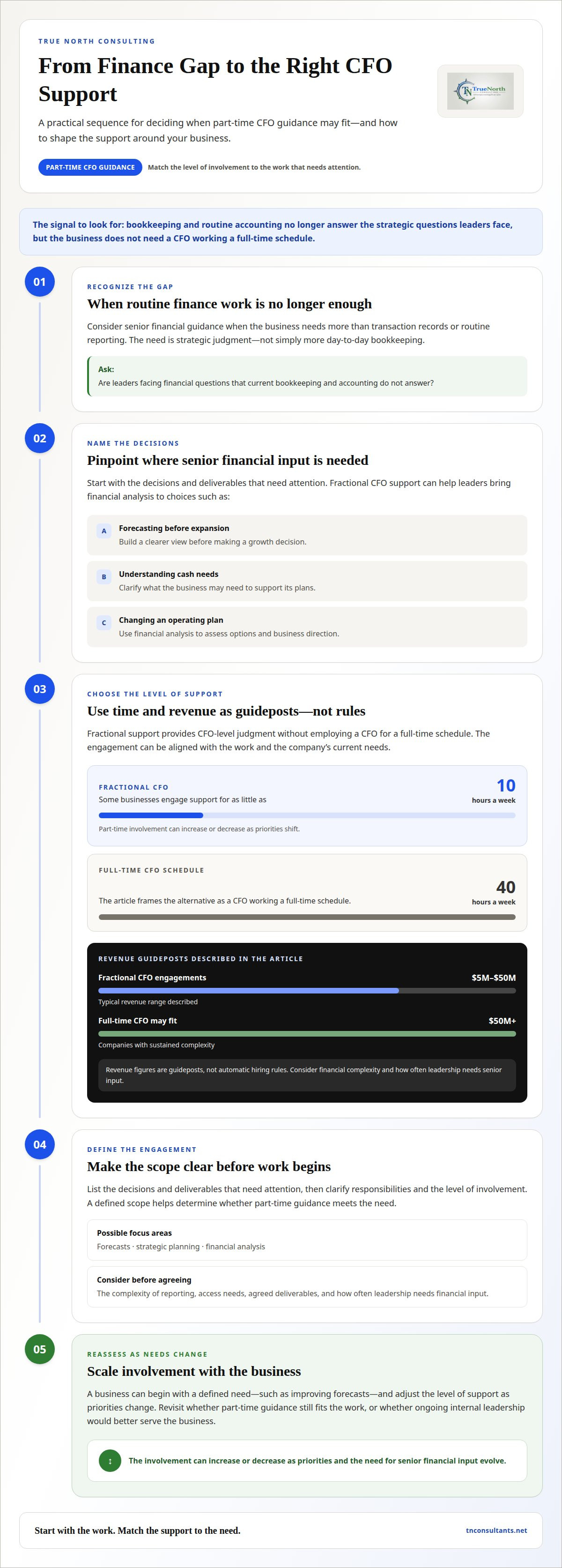
A growing business doesn’t always need a full-time CFO. Fractional CFO services can make sense when bookkeeping and accounting no longer answer the strategic questions leaders face, but the business doesn’t need a CFO working 40 hours a week. Some companies engage a fractional CFO for as little as 10 hours a week.
It’s reasonable to ask whether your next finance hire should be a CFO, controller, accountant, or bookkeeper. The right fit depends on the work your business needs: daily transaction records, reliable financial reporting, or senior guidance on forecasts, strategy, and major financial decisions.
This article explains when fractional CFO support is useful, how it compares with a full-time CFO, and how the role differs from other finance professionals. You’ll also learn what the work can include and which factors shape an engagement.
Key Takeaways
- Consider part-time CFO support when financial decisions require senior guidance but not a full-time executive.
- Match the role to the gap: bookkeeping records transactions, accounting supports statements and taxes, and a controller oversees accounting operations.
- Assess a finance professional’s experience and industry knowledge against the decisions your business needs to make.
- Use forecasting, strategic advice, and financial analysis to bring greater clarity to business planning and high-stakes choices.
Benefits compared with a full-time CFO
A fractional CFO brings senior financial judgment without requiring a company to employ a CFO 40 hours a week. Some businesses engage this support for as little as 10 hours a week. That difference can help owners add strategic oversight while keeping the role’s time commitment aligned with current needs. As priorities shift, the level of involvement can increase or decrease.
Fractional CFO services can suit a business facing decisions that require more than bookkeeping or routine reporting. Leadership might need a forecast before expanding, a clearer view of cash needs, or financial analysis before changing an operating plan. A fractional CFO can help shape strategy and advise on significant financial decisions without requiring a full-time executive hire.
- Scale the support: Begin with a defined need, such as improving forecasts, then adjust involvement as priorities change.
- Focus senior expertise: Use CFO-level judgment for decisions that affect planning, cash flow, or business direction.
- Match the role to complexity: Companies with $5 million-$50 million in revenue are described as a typical range for fractional CFO engagements.
- Reassess the structure: A full-time CFO may fit companies with $50 million or more in revenue and sustained complexity.
Revenue figures are guideposts, not automatic hiring rules. Consider the complexity of your finances and how often leadership needs senior financial input. A smaller business may still face complex planning needs, while a larger company may have a different finance structure. Start with the work, then choose the level of support that fits.
Fractional CFO services also let businesses access expertise from a professional who may support multiple companies simultaneously. That arrangement differs from relying on one executive for a full-time schedule. Before engaging support, list the decisions and deliverables that need attention, such as forecasts, strategic planning, or financial analysis. A clear scope helps determine whether part-time guidance meets the need or ongoing internal leadership would better serve the business.
Fractional CFO team qualifications and industries
Start by matching a CFO’s experience to your business decisions, not just a title. Fractional CFOs typically bring 10-20+ years of corporate finance experience. A CPA, MBA, or CFA can help establish professional credibility, though these credentials aren’t required.
How do I choose and vet a fractional CFO provider? Ask about experience with challenges like yours, then discuss how the provider would approach forecasting, reporting, and strategic decisions. Clarify deliverables, communication, and responsibilities before agreeing on the scope.
Industry familiarity matters because revenue models, operating costs, and reporting needs vary. For example, cannabis businesses have specialized accounting needs tied to their regulatory, compliance, and IRC 280E requirements. Ask how a provider’s relevant experience connects to the decisions your business needs to make.
How much do fractional CFO services cost in the United States? The price depends on the scope and is provided after a quote request; key factors include reporting complexity, access needs, and agreed deliverables.
How are fractional CFO fees structured: hourly, monthly retainer, or project-based? Engagements may use hourly billing, a recurring retainer, or a project fee. The structure depends on whether you need defined work, ongoing guidance, or flexible support.
What are the risks or limitations of hiring a fractional CFO? Part-time availability may not suit a business that needs daily executive oversight. Unclear responsibilities or unreliable financial records can also limit the value of the analysis.
How does a fractional CFO engagement typically work, from onboarding to ongoing reporting? It starts with clarifying goals, reviewing financial information, and defining responsibilities. Ongoing work can include agreed reporting, forecasts, and leadership discussions.
Use these points to compare providers against your needs. A focused conversation about fractional CFO support can help define the work and the level of involvement.
Fractional CFO versus controller, interim CFO, accountant, and bookkeeper
A fractional CFO provides senior financial guidance on a part-time basis. “Part-time” describes the schedule; “fractional” emphasizes that CFO capacity is shared across businesses. “Virtual” describes remote delivery, not a different finance role. For example, a virtual fractional CFO may advise leadership through online meetings and financial reports.
Other finance roles focus on different work. A bookkeeper records transactions and maintains accurate daily records. An accountant typically prepares financial statements and tax returns, and performs reconciliations. A controller manages accounting operations, reporting, and compliance, and may oversee payroll and audits. A fractional CFO uses financial information to support planning and leadership decisions.
- Bookkeeper: Records sales, expenses, and payments so daily financial data stays organized.
- Accountant: Prepares statements, handles tax preparation, and reconciles accounts for accurate financial records.
- Controller: Oversees reporting and accounting processes, including compliance, payroll, and audits.
- Fractional CFO: Helps leaders interpret financial results, assess options, and plan business decisions.
An interim CFO fills a different need. This role usually provides temporary, full-time leadership during a transition, such as when a CFO leaves and the company needs continuity. A fractional CFO instead provides ongoing, part-time senior guidance. The distinction is whether your business needs temporary full-time coverage or a defined share of CFO-level support.
Consider a business evaluating an expansion. The bookkeeper records related transactions, and the accountant prepares accurate statements. The controller organizes reporting and accounting controls. The CFO evaluates the financial implications and advises leaders on the decision. Each role contributes, but the strategic question belongs at the CFO level.
To identify the gap, list the work that is delayed or missing. If transaction records need attention, start with bookkeeping. If reporting needs oversight, consider controller responsibilities. If leaders need financial direction, CFO support may fit. Clear role boundaries help each professional contribute without confusing strategic advice with accounting execution.
What services does a fractional CFO provide?
A fractional CFO turns financial information into choices leaders can act on. Core work includes building forecasts, shaping strategy, and advising on important decisions. For example, a forecast can compare expected revenue and costs under different assumptions. Leaders can then assess how a proposed expansion might affect cash needs and operating plans.
The value comes from interpreting the figures, not simply presenting them. A CFO can identify which assumptions drive a forecast, where actual results differ from expectations, and what those differences may mean for business plans. If sales fall below forecast, leadership can review the assumptions and weigh possible responses using current financial information.
- Forecasting: Organize financial assumptions into a forward-looking view. Compare scenarios, such as expected results with and without a planned change.
- Strategy: Connect financial analysis to business priorities. A leadership team weighing expansion can examine how its plan fits the available financial picture.
- Decision support: Frame the financial implications of a major choice. Present options and the assumptions behind them so leaders can make an informed decision.
- Ongoing guidance: Review updated information with leadership and revisit forecasts as business conditions or plans change.
Set the scope around decisions your team needs to make. Start by naming the questions that lack clear financial answers. Then identify the information needed, the expected analysis, and how findings will reach decision-makers. For example, a team considering a new operating plan can agree on assumptions to compare and the reporting needed to discuss the results.
Clear boundaries matter. A CFO’s strategic analysis depends on financial records that support useful decisions, while transaction entry and routine accounting remain distinct work. Define responsibilities, deliverables, and meeting cadence at the outset. If you need senior guidance with forecasting or financial strategy, discuss fractional CFO support as a way to scope that work.
True North Consulting: Fractional CFO services
True North Consulting provides fractional CFO support for businesses that need clearer financial planning, forecasts, and guidance on important decisions. Its accounting and tax services can also support the financial information leaders use to plan and operate. For cannabis businesses, specialized accounting addresses distinct regulatory, compliance, and IRC 280E requirements.
Consider fractional CFO support when you need senior financial perspective alongside accounting or tax support, or when your operations involve cannabis-specific accounting. A practical starting point is to describe the decisions you’re facing and the financial work that would help inform them.
Contact True North Consulting to discuss your needs, or visit tnconsultants.net.
Set a Clear Financial Priority
Your next step doesn’t have to be a broad finance overhaul. Choose one decision that needs stronger financial direction, such as setting a planning priority or clarifying what information leadership needs. Write down the question, the information you already have, and what a useful answer would help you decide.
This brief gives a conversation with a financial advisor a practical starting point. It also helps you assess whether fractional CFO services fit the work ahead, rather than choosing a role based on title alone. As your priorities develop, define the scope around the decisions that matter most to your business.
True North Consulting can discuss how its financial support may align with your priorities. Contact True North Consulting to start a conversation about the questions your business needs to answer. A clear first step can make the next financial decision easier to approach.
Frequently Asked Questions
When Do You Need a Fractional CFO?
Consider fractional CFO support when leadership needs financial analysis to make a decision, but the immediate need is strategic guidance rather than another full-time executive. A business may be growing while cash timing becomes harder to manage, or owners may need a clearer financial view before changing plans. The key signal is an important business decision that current reporting alone doesn’t resolve.
Do your fractional CFOs provide insights on tax strategies and compliance?
True North Consulting provides tax planning, preparation, and advisory services for businesses. Owners can address tax questions alongside financial planning. Before changing operations, for example, a business can discuss its financial plan and related tax considerations together. Tax compliance requires accurate records and careful attention to applicable obligations, so keep financial information organized and raise tax questions early.
How can a fractional CFO benefit my business compared to a full-time CFO?
Fractional CFO services focus senior financial attention on the work your business needs now. This can help owners direct resources toward priorities such as improving budget visibility or assessing an operating decision, rather than creating a full-time role before its responsibilities are clear. Compare the work required, how continuously it is needed, and how closely financial leadership must be involved in daily decisions.
How do you match a fractional CFO to my business's specific needs and growth stage?
Start by describing your current operating stage, upcoming decisions, and the financial questions your team struggles to answer. A Virginia business preparing to expand, for instance, may need planning aligned with its next operating priorities. True North Consulting tailors fractional CFO services to business needs, so a conversation can focus on how the support fits your goals.
How do your fractional CFOs collaborate with my existing accounting team?
Good collaboration starts with clear ownership of financial records, analysis, and decisions. True North Consulting provides accounting support, including bookkeeping, reporting, and reconciliations. With responsibilities defined, your team can maintain records while CFO-level work uses that information for planning and business decisions. Share reporting processes and identify who prepares, reviews, and uses each report.
What is the minimum commitment required for engaging a fractional CFO?
Set the commitment around the agreed scope, deliverables, and meeting cadence rather than assuming one schedule fits every business. Before work starts, define priorities, expected reporting, and how often leadership will review progress. Agree on when to revisit the scope as needs change. These details clarify the time commitment and keep the engagement tied to practical business needs.