

Can AI Catch a Cannabis Accounting Problem Before Your Accountant Does?
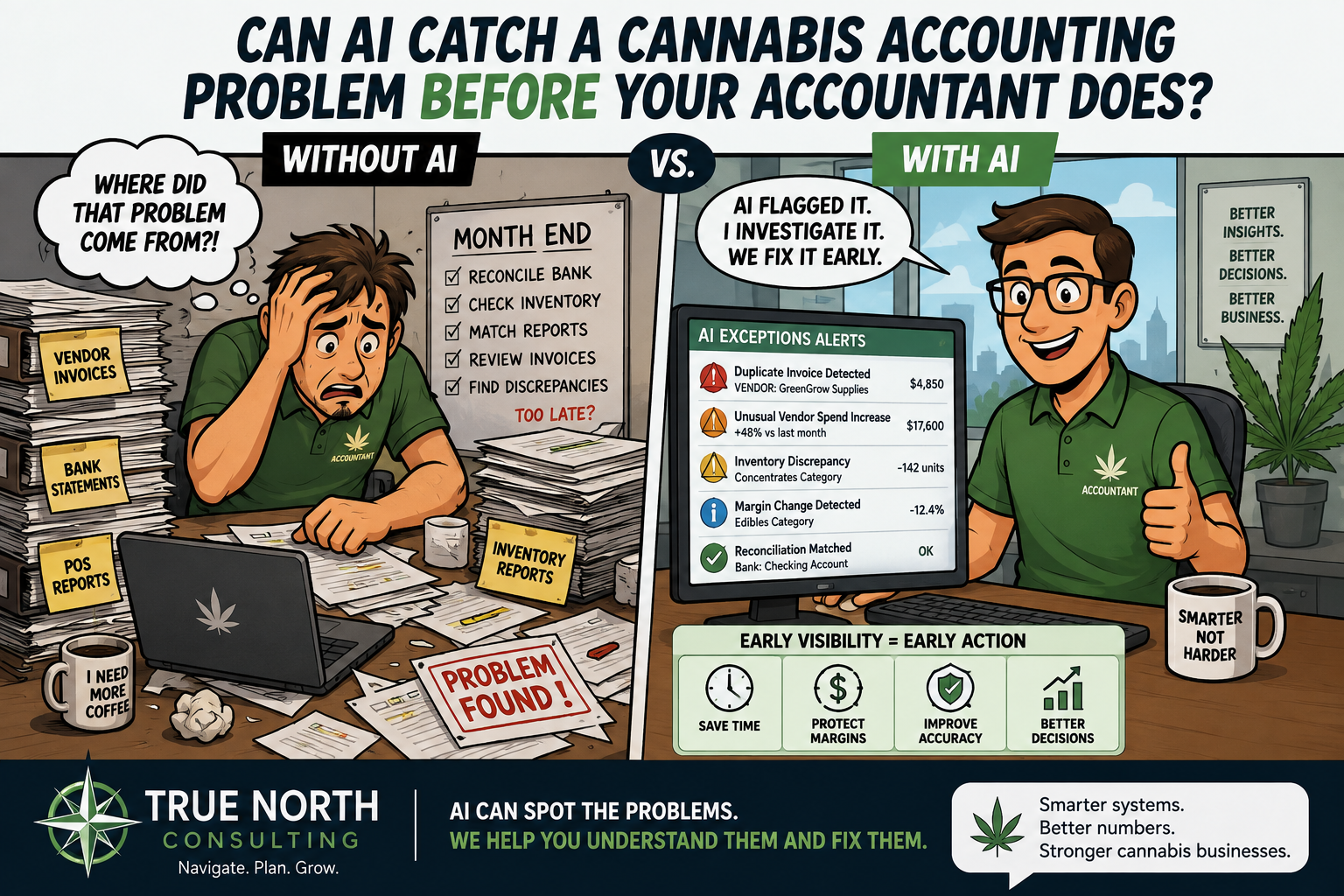
A strange transaction hits the books.
A vendor invoice appears twice. Inventory suddenly does not match. A product category that normally produces a healthy margin starts slipping. A supplier’s costs jump unexpectedly.
Normally, someone discovers the problem during reconciliation.
Sometimes that is days later. Sometimes it is weeks later. And sometimes the problem is not noticed until month end, tax planning, or financial review.
But what if your accounting system could notice something was wrong before your accountant did?
That is where AI and automation are beginning to change the way cannabis businesses approach accounting.
AI does not need to replace the accountant
There is a lot of discussion about AI replacing people. That is not the most interesting opportunity for cannabis accounting.
The better question is:
What if AI could do the watching while your accountant does the thinking?
Cannabis businesses generate enormous amounts of information every day. POS transactions, inventory movements, vendor invoices, bank transactions, purchasing records, sales reports, payroll, COGS, and data moving between multiple systems.
The challenge is not always having the information.
The challenge is noticing when something does not look right.
AI can help by continuously looking for unusual patterns and bringing the exceptions to the attention of the people who need to investigate them.
Imagine your books had a second set of eyes
Suppose your cannabis business normally spends around $35,000 a month with a particular supplier.
Then one month, the number jumps to $52,000.
Nothing is necessarily wrong. Maybe there was a large purchase.
But maybe there was a duplicate invoice. Maybe inventory was received differently than expected. Maybe a payment was recorded incorrectly.
A traditional accounting process may identify the issue during reconciliation.
An automated system can potentially flag the unusual change much earlier.
The accountant can then investigate.
That distinction is important.
AI identifies the question. The accountant answers it.
Inventory is another opportunity
Inventory is one of the areas where automation can become particularly valuable for cannabis operators.
Products move through purchasing, inventory, sales, transfers, adjustments, and reporting systems. When those systems do not line up, someone eventually has to investigate the difference.
Imagine an automated system notices that inventory reported by one system does not match another.
Instead of someone discovering the difference at the end of the week, the discrepancy can be flagged for review.
Was there a transfer?
Was a sale recorded incorrectly?
Was inventory adjusted?
Was there a synchronization issue?
Was something entered manually?
The technology does not necessarily need to decide the answer.
It simply needs to make sure the question gets asked.
AI can spot changes in profitability too
This is where automation becomes particularly interesting for business owners.
Imagine a product category normally produces a healthy gross margin.
Then the margin starts falling.
Sales are still strong, so nobody immediately notices.
An automated system could flag the change.
The accountant investigates and discovers that supplier costs increased several months ago while pricing never changed.
That is no longer just an accounting issue.
It is a business decision.
The owner may need to adjust pricing, negotiate with the supplier, change purchasing decisions, reconsider promotions, or rethink the product mix.
The earlier the problem is identified, the more options the owner has.
Automation can remove the repetitive work
There is another benefit that deserves more attention.
Accountants spend a significant amount of time on repetitive work.
Downloading reports. Matching transactions. Entering invoices. Comparing spreadsheets. Checking balances. Searching for missing documents. Reviewing large numbers of transactions looking for something unusual.
Much of this work is necessary.
But not all of it requires a human spending hours searching through data.
Automation can handle repetitive processes while AI can help identify transactions or patterns that deserve attention.
That allows accountants to spend more time reviewing exceptions, understanding the numbers, and helping the business make decisions.
That is a much better use of human expertise.
But AI should not make every decision
This is where cannabis accounting becomes particularly important.
AI can identify a pattern. It can flag an unusual transaction. It can suggest that two invoices may be duplicates. It can identify an inventory discrepancy.
But that does not mean it should automatically determine the accounting or tax treatment.
Cannabis businesses operate in a complicated regulatory and tax environment. Determining the appropriate treatment of a transaction can require context, professional judgment, and an understanding of the business.
The goal should not be human versus AI.
It should be human plus AI.
Technology can identify what deserves attention. An experienced accounting professional can determine what it means and what should happen next.
What could a modern cannabis accounting workflow look like?
Imagine transactions flowing into the accounting system automatically.
Invoices are captured.
Bank transactions are matched.
Inventory data is connected.
The system continuously looks for unusual activity.
A margin changes significantly.
Flag it.
An invoice appears twice.
Flag it.
Inventory does not reconcile.
Flag it.
A vendor's costs suddenly increase.
Flag it.
Instead of an accountant spending the entire day searching for problems, the accountant receives a list of exceptions worth investigating.
The technology does the searching.
The accountant does the thinking.
The owner gets better information faster.
That is where cannabis accounting is heading.
The opportunity is not replacing your accountant
It is giving your accountant better tools.
A strong accounting function should not spend most of its time searching for problems that technology could identify automatically.
It should spend more time understanding why those problems happened and what they mean for the business.
A cannabis operator does not need another dashboard simply because it has the word “AI” on it.
They need better answers.
Where are we making money?
Where are we losing money?
What changed?
What needs attention?
What could become a problem?
What should we do next?
Technology can help uncover those questions.
Experienced financial professionals help answer them.
How True North Consulting can help
At True North Consulting, we believe technology should make accounting smarter, not remove the human judgment that good financial management requires.
We help cannabis businesses improve bookkeeping, financial reporting, reconciliation processes, COGS tracking, inventory visibility, and financial controls. As automation and AI become more capable, there is an opportunity to use those tools to reduce repetitive work, identify exceptions earlier, and give business owners better financial information.
The objective is simple:
Spend less time hunting for problems and more time solving them.
If your accounting team is still spending hours moving information between spreadsheets, manually comparing reports, or discovering problems only after month end, it may be time to rethink the process.
True North Consulting can help you identify where automation makes sense, where human review remains essential, and how the two can work together.