

Your Business Is Growing. Is Your Cash Flow Growing With It?
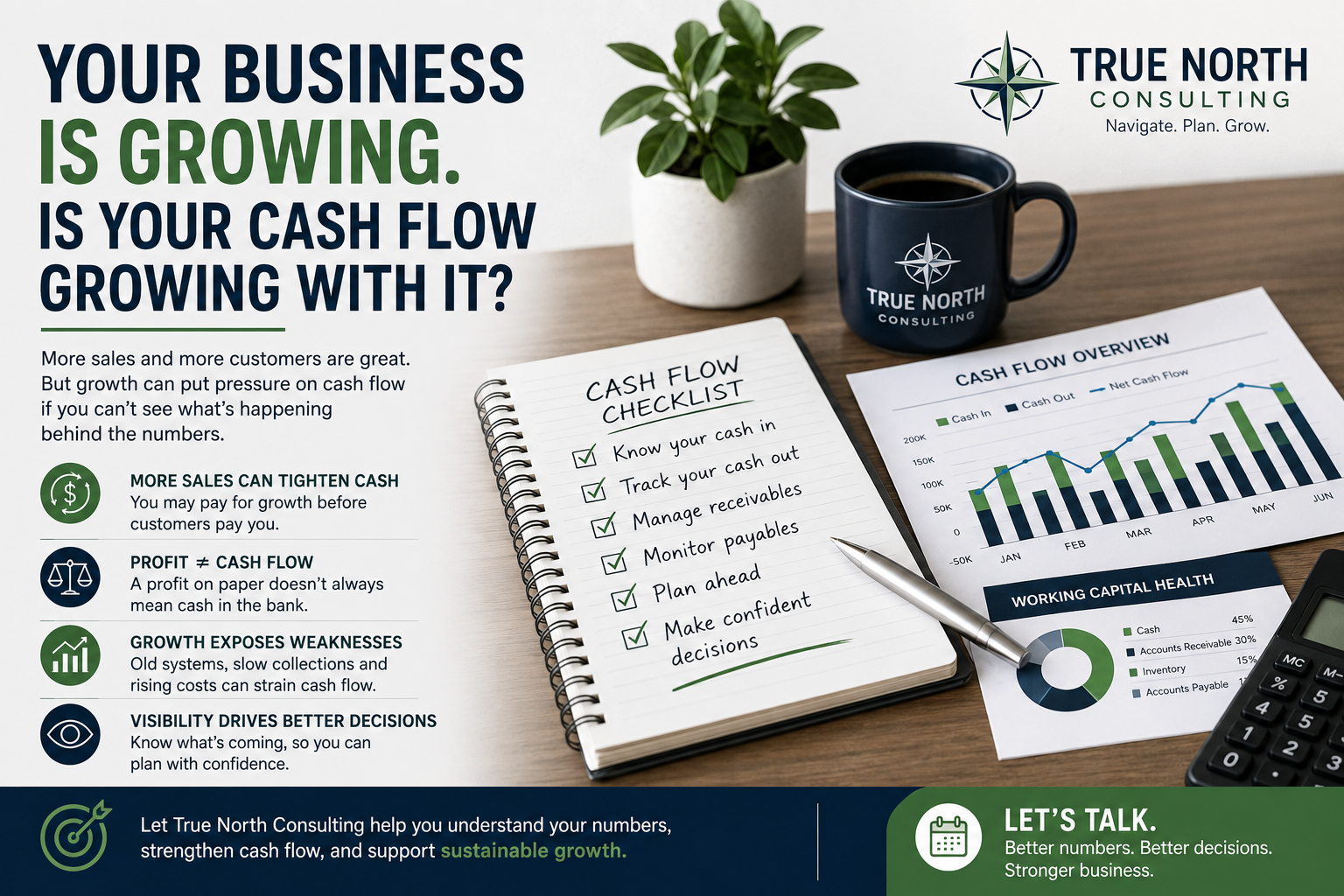
Growth is supposed to feel good.
More customers. More sales. More employees. Bigger contracts. More opportunities.
But there is a strange moment that many business owners eventually experience.
The business is growing, the financial statements show more revenue, and yet the bank account somehow feels tighter than it did before.
So where is all the money going?
When growth starts eating cash
Imagine a business that has just landed several large new customers. Revenue is climbing and the owner is excited about what the next year could look like.
But those customers are paying in 30, 60, or even 90 days.
Meanwhile, the business has to pay employees now. Suppliers want to be paid now. Rent, software, insurance, taxes, and other operating costs continue every month.
The business is growing, but the cash needed to support that growth is going out before the revenue comes in.
This is one of the reasons a profitable business can still experience cash flow pressure.
Profit and cash are telling different stories
Your profit and loss statement might show a healthy profit while your bank account tells you to slow down.
That does not necessarily mean something is wrong with your accounting.
It means profit and cash flow are measuring different things.
You may have revenue sitting in unpaid customer invoices. You may have purchased inventory that has not yet been sold. You may have invested in equipment, hired additional staff, or started paying down debt.
All of those things can affect cash without necessarily appearing as a simple reduction in profitability.
The problem begins when the owner only looks at the profit and loss statement or the bank balance and assumes either one tells the whole story.
It does not.
Growth can expose weak financial systems
A business can sometimes get away with informal financial habits when it is small.
The owner knows the customers personally. There are fewer invoices. There are fewer employees. The number of bills is manageable and the bank account is relatively easy to monitor.
Then the business grows.
Suddenly there are more customers, larger receivables, more suppliers, higher payroll, bigger tax obligations, inventory commitments, loans, and more decisions happening at the same time.
The financial system that worked at $500,000 in revenue may not work nearly as well at $2 million.
That is when owners often start asking:
“We're making more money than ever. Why does cash still feel so tight?”
Your bank balance should not be your forecasting tool
Looking at the bank account tells you how much cash you have today.
It does not necessarily tell you how much cash you will have three weeks from now.
A growing business needs to understand what is coming.
Which customers are expected to pay?
Which invoices are overdue?
What bills are coming due?
What will payroll look like?
What taxes need to be set aside?
Are there large purchases or debt payments ahead?
How much cash does the business actually need to operate comfortably?
These questions turn cash flow from something you react to into something you can manage.
The numbers should help you see around the corner
Good financial reporting should not simply tell a business owner what happened last month.
It should help them understand what is happening now and prepare for what comes next.
That means having reliable information about accounts receivable, accounts payable, profitability, margins, working capital, debt, and cash flow.
When those numbers are reviewed consistently, the owner can spot problems earlier.
Maybe customers are taking longer to pay. Maybe inventory is growing faster than sales. Maybe margins are shrinking even though revenue is increasing. Maybe the business is taking on commitments that its current cash flow cannot comfortably support.
Those are much easier problems to solve when you see them early.
Growth should create opportunity, not constant financial anxiety
A growing business should not have to choose between taking the next opportunity and worrying about whether there will be enough cash to pay the bills.
Sometimes the answer is not simply to sell more.
The business may need to improve collections, manage inventory differently, negotiate payment terms, review margins, control expenses, or simply understand its cash requirements more clearly.
That is why financial visibility becomes increasingly important as a business grows.
The bigger the business becomes, the more expensive it can be to make decisions without reliable numbers.
How True North Consulting can help
At True North Consulting, we help business owners understand what is happening behind the numbers.
Our work goes beyond simply recording transactions. We help businesses build reliable financial reporting, understand cash flow, improve financial visibility, and use their numbers to make better decisions.
For a growing business, that can mean identifying cash pressure before it becomes a crisis, understanding where working capital is being tied up, and giving the owner a clearer picture of what the business can realistically afford to do next.
Because sometimes the problem is not that the business is not making enough money.
The problem is that growth is consuming cash faster than the owner can see it.
If your business is growing but your cash flow does not seem to be keeping up, it may be time to look beyond the bank balance and understand what the numbers are really telling you.
True North Consulting can help you find the answer.
Final thought
Growth is exciting.
But growth without financial visibility can quickly become stressful.
The goal is not simply to build a bigger business. It is to build a business that can financially support the growth it is experiencing.
When you know where your cash is going, what is coming next, and what your business can actually afford, growth becomes much easier to manage.