


Business financial forecasting turns assumptions about sales, expenses, and cash into a forward-looking view of what a company may need and can afford. Short-term forecasts commonly cover periods from a day or week up to three months, while long-term forecasts often span one to five years.
A forecast is more than a spreadsheet exercise. For a startup, it is a decision tool that links sales expectations to hiring, inventory, spending, and cash needs, while making clear which assumptions drive the plan.
This article explains what a forecast includes, how to make revenue and expense estimates more realistic, and how to use best-case, base-case, and worst-case projections in a startup plan or investment discussion. It also covers how comparing projections with actual results and updating assumptions keeps a forecast useful as conditions change.
Key Takeaways
- Understand how a forecast differs from financial planning and accounting, and what each contributes to startup decisions.
- Build sales and expense estimates from operational evidence and clear assumptions, not best-case hopes.
- Use multiple scenarios to show how changing conditions could affect cash needs and investment choices.
- Keep startup projections useful by comparing them with actual results and revising them as the business changes.
What Is Financial Forecasting?
Financial forecasting uses historical results and stated assumptions to project future revenue, expenses, cash flow, and profit. Accounting records past activity, financial planning sets goals, and a forecast tests whether expected results can support those goals.
Reserves and Long-Term Financial Planning
A reserve is money set aside for future needs, while structural balance means recurring revenue covers recurring expenses. The Government Finance Officers Association recommends that governments forecast major revenues and expenditures over several years. For a business, projecting cash and spending helps show whether operations can support planned commitments. Long-term forecasts commonly span one to five years, connecting today’s decisions with their future financial effects.
Forecasting Models and Scenario Planning
A forecasting model applies assumptions to financial information to produce projections, while scenario planning compares possible outcomes. Businesses can prepare monthly forecasts with best-case, base-case, and worst-case scenarios. A straight-line model extends an observed trend into future projections, but it assumes the trend will continue. It is simple, but assumes the trend will continue. Prepare projected income statements, cash flow projections, and balance sheet estimates to show different parts of the financial picture.
Choose forecasting software or consulting support based on data quality, reporting needs, and how often assumptions must change. The right fit depends on which decisions the forecast needs to inform.
Forecasting for Uncertainty and Market Changes
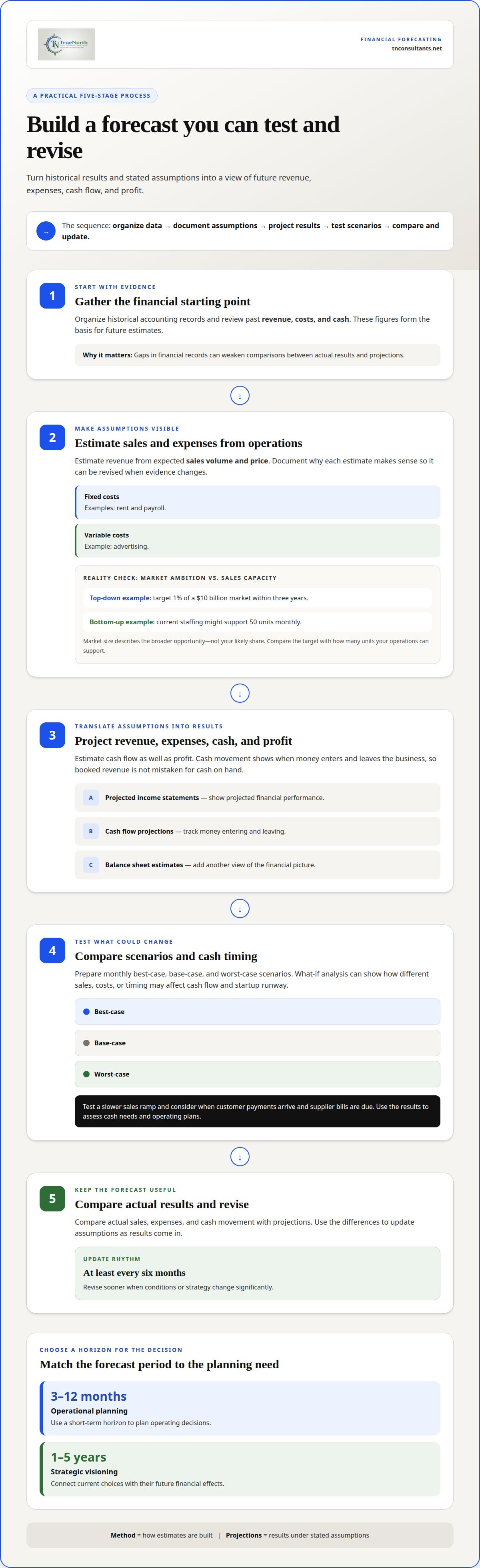
Forecasts help you see how changing conditions could affect cash needs and operating plans. Start with historical revenue, costs, and cash data, then document assumptions about sales, pricing, and expenses. Estimate revenue from expected sales volume and price; separate fixed costs, such as rent and payroll, from variable costs, such as advertising. Project cash movement to see how timing affects available funds, then compare actual results with projections and revise them. Update forecasts at least every six months, or sooner when conditions or strategy change significantly.
Forecasts for Strategic Decisions
Forecasts connect financial analysis with decisions about spending, staffing, and growth. A startup can use monthly sales projections to assess inventory and production needs, then compare expected cash flow with planned commitments. To build a forecast, organize historical accounting records, set assumptions, project revenue and expenses, and estimate cash flow and profit. Accuracy depends on the quality of the data and assumptions, so use actual results to inform each update. Business financial forecasting turns these comparisons into a clearer basis for deciding what the business can support.
Avoiding optimistic revenue and underestimated expense projections
Forecasts lose value when expected sales exceed operating capacity or expenses omit real obligations. Distinguish the forecasting method from its projections: the method explains how estimates are built, while projections show the results under stated assumptions.
Sales Projections and Market Size
Sales projections estimate revenue from expected units sold and prices; market size describes the broader opportunity, not your likely share. A top-down plan might target 1% of a $10 billion market within three years, but that target alone doesn’t show how customers will find or buy the product. A bottom-up estimate starts with delivery capacity: current staffing might support 50 units monthly. Comparing both views exposes gaps between ambition and sales capacity.
What-If and Cash Flow Projections
What-if analysis changes assumptions to show how sales, costs, or timing affect cash flow and startup runway. Model a slower sales ramp alongside expected expenses, then examine how the timing of customer payments and supplier bills affects available cash. A cash flow projection tracks money entering and leaving the business, rather than treating booked revenue as cash on hand. This helps identify when spending plans may need to change.
Projection Assumptions and Time Horizon
Document assumptions so each estimate has a reason and can be revised when evidence changes. If historical cost of goods sold was 30% of sales, carrying that ratio forward is an assumption, not proof it will persist. Include expense buffers and account for fixed and variable costs; otherwise, a rising sales estimate can hide the spending needed to deliver it. Choose a short-term horizon of 3-12 months for operational planning and 1-5 years for strategic visioning.
As results come in, compare actual sales, expenses, and cash movement with projections, then adjust the assumptions. Gaps in financial records can weaken that comparison, so keep the underlying figures organized before revising the forecast.
Using projections for business plans and investment decisions
Projections translate operating assumptions into expected financial results for your business plan. They connect plans for sales, hiring, and spending with the cash those decisions require.
Projections in Business Plans
A business plan uses projections to show how sales and expenses may develop over time. A startup sales forecast can estimate monthly units and prices during its first two years, then provide quarterly estimates beyond year two. This detail links expected demand with staffing and inventory plans. Lenders and investors often look for a three-year sales forecast, so clear assumptions help explain how the business expects to perform.
Forecasts for Investment Decisions
Forecasts help assess whether a proposed investment fits the business’s financial capacity. Compare the investment’s expected cash flows and expenses with projected operating results, then model how different outcomes could affect available cash. For example, a slower sales ramp may change when new equipment or additional inventory makes sense. A forecast supports the decision by showing its financial effects, not by presenting projected results as certain.
Forecasts for Business Decisions
Business forecasts link expected sales with decisions about inventory, production schedules, and staffing. If a sales forecast changes, assess whether current staffing can meet expected demand before committing to additional capacity. A retailer can also use projected sales by product to inform inventory orders. These comparisons help owners weigh operating needs against cash flow and adjust plans as results change.
Connecting Forecasts to Budgets
A budget turns forecast assumptions into planned spending for a defined period, such as a quarter. Compare projected revenue with fixed expenses, variable expenses, and planned investments before setting spending limits. If expected sales fall short, revise discretionary spending or timing instead of assuming revenue will recover. As actual results come in, compare them with both the forecast and budget to identify assumptions to update and inform the next budgeting decision.
Startup financial forecast purpose and benefits
A startup forecast turns a business idea into a testable view of revenue, expenses, cash needs, and profitability. It informs financial planning before operations generate a reliable record of results. Established companies can draw on historical data; startups must base early estimates on marketplace evidence, planned capacity, and explicit assumptions. A forecast should describe a working plan, not present an uncertain estimate as a promise.
A startup forecast commonly covers the first three years, but each period serves a different purpose. Near-term projections help you plan cash needs and operating decisions, while later estimates show how the business expects to move toward sustainable performance. If the startup has no historical financial statements, its cash-flow projection can begin with a statement broken down into 12 months. That monthly view helps expose timing gaps between expected cash receipts and planned spending.
Startups and established companies differ most in the evidence behind their estimates. An established company can use past sales, expenses, and cash patterns to identify trends. A startup has fewer operating results, so its forecast depends more on marketplace information, test marketing, surveys, planned unit sales, and pricing assumptions. As actual results accumulate, compare them with the original estimates. This can show whether sales volume, expense assumptions, or the path to profitability needs revision.
Keep the forecast useful as the business changes. Update it at least every six months, and sooner when conditions or strategy change significantly. Record the assumptions behind each revision so the next review can distinguish new evidence from changed expectations. A founder moving from planning to launch can use those comparisons to explain operating needs and financial capacity in a business plan. If you want support turning startup assumptions into useful projections, discuss your startup forecast.
True North Consulting
True North Consulting can help when your forecast needs stronger financial records, clearer reporting, or support connecting projections to business decisions. Its accounting services help organize financial information, while Fractional CFO services provide advisory support for financial insight and growth planning. For cannabis businesses, specialized cannabis accounting addresses industry-specific accounting needs, including IRC 280E considerations.
This support can help when sales assumptions change, actual results differ from projections, or you need a clearer view of cash flow and growth plans. Well-organized accounting records give forecasts a stronger foundation, while advisory support helps interpret results and consider next steps.
Contact True North Consulting to discuss your forecasting and accounting needs.
Put Your Next Forecast to Work
A forecast proves its value when it informs a real decision. Identify the next decision on your horizon, then make sure the assumptions and expected effects are clear to the people responsible for acting on them. Treat projections as a working management tool, not a document that goes untouched after planning.
As your business changes, consistent business financial forecasting helps keep decisions grounded in current financial information. True North Consulting offers fractional CFO, tax, and accounting services to Virginia businesses and across the United States. Its team can help turn financial information into practical insight for your business.
If you’re ready to make your projections more useful for planning, contact True North Consulting to discuss your needs. A clear next step can make the decisions ahead easier to approach.
Frequently Asked Questions
What are financial projections?
Financial projections estimate future business performance for planning; they are not records of results that have already happened. For example, if a planned opening date moves, the expected timing of sales and pre-opening activity may shift too. Label the period and assumptions behind a projection so readers understand what the figures represent and do not mistake a planning estimate for an actual result.
Why use both top-down and bottom-up forecasting?
Using both approaches helps test whether a market opportunity and your operating plan support a plausible sales target. A top-down view can frame the opportunity, while a bottom-up view shows what customer activity must support the target. If the estimates diverge, examine the assumptions behind the difference, such as expected market share or sales capacity, before relying on either estimate for a major commitment.
What is business financial forecasting?
It’s a way to assess a business decision’s financial effects before committing to it. For example, a cannabis retailer considering a new product category can examine how its expected purchasing schedule and sales mix may affect working cash. The resulting view gives owners a basis for discussing tradeoffs with decision-makers, rather than relying only on the hoped-for outcome.
What methods and software are used for business financial forecasting?
Businesses can forecast with spreadsheets, accounting software, or dedicated forecasting tools. Choose a method and tool that fit the purpose: a simple operating plan may need only clear, linked assumptions, while a more involved plan may require input from several departments. Keep assumptions visible and note where figures came from so others can understand how the estimate was built.
How to use best-case, base-case, and worst-case scenarios in forecasting?
Give each scenario its own assumptions and connect it to a management response. For instance, a base case might support planned hiring, while a slower-sales case could prompt a delay. Identify the signal that would trigger a change in plan, such as a shift in order activity. This makes scenario comparisons useful in meetings because each outcome links to a possible action.
What are common financial forecasting mistakes and risks?
False precision is a common risk: detailed-looking figures can still rest on weak assumptions. Another mistake is letting departments use different sales or staffing assumptions in the same plan. Use a shared set of inputs and identify who owns each assumption. For a cannabis business, connect financial estimates to relevant operational information so the forecast reflects how the business actually runs.