


A full-time CFO isn't always the right next step: a fractional CFO in Virginia can provide part-time financial leadership when your business needs clearer forecasts, stronger reporting, or guidance on a major decision. Engagements commonly involve 10 to 25 hours of work per week and focus on forward-looking planning, not just recording past transactions.
Learn what a fractional CFO in Virginia does, how fractional, interim, and full-time CFO support differ, and how to get practical guidance from the relationship. You’ll also learn when your business needs strategic financial oversight rather than day-to-day bookkeeping.
Key Takeaways
- Separate routine bookkeeping from financial leadership: choose support that matches whether you need accurate records or forward-looking planning.
- Use regular forecasts and performance reviews to spot cash pressure, changing expenses, and opportunities to improve profitability.
- Match onsite, remote, or hybrid collaboration to the work, communication needs, and access to your financial information.
- Compare fractional, full-time, and interim CFO support by the duration and level of leadership your business needs.
Ongoing financial guidance and progress monitoring
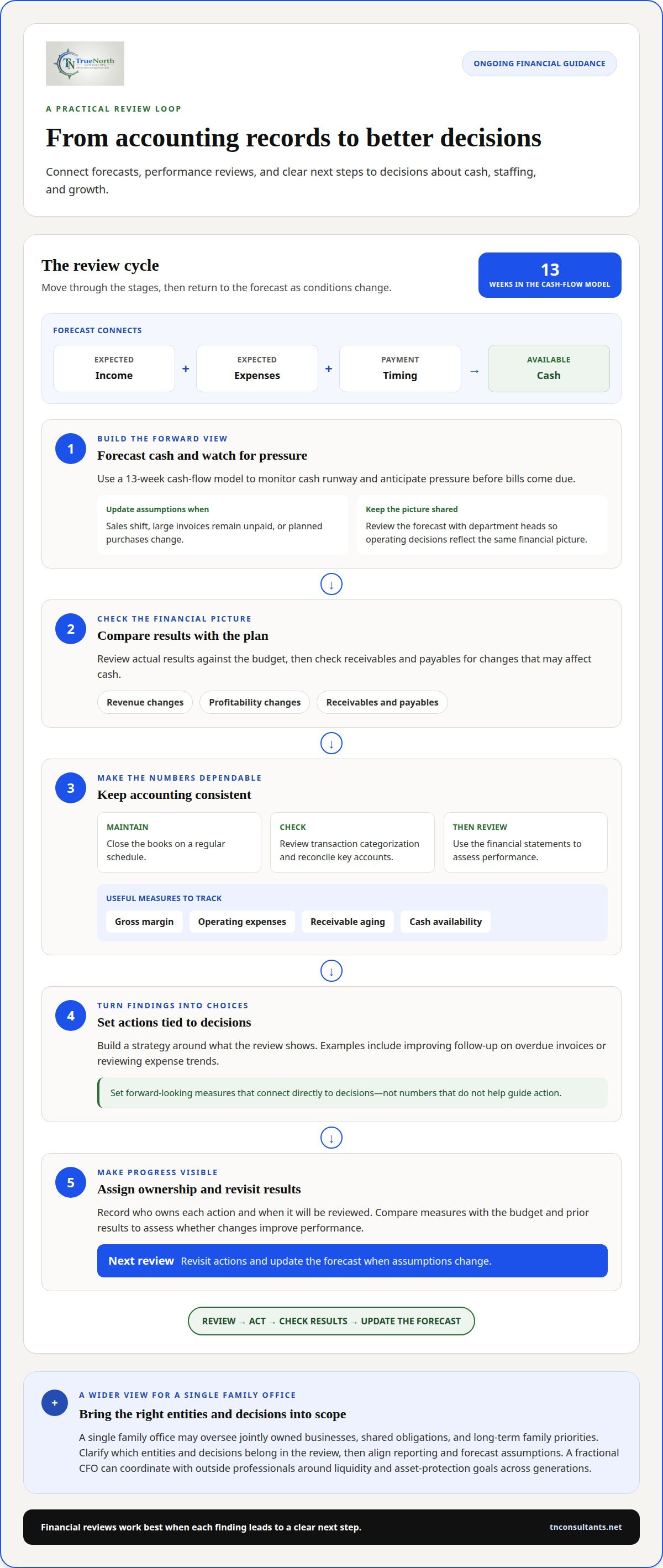
Ongoing guidance turns accounting records into decisions about cash, staffing, and growth. In each review, compare actual results with the plan and assign a clear next step.
Financial Planning and Forecasting
A forecast connects expected income, expenses, and payment timing to available cash. A 13-week cash-flow model can help you monitor cash runway and anticipate pressure before bills come due. Update assumptions when sales shift, large invoices remain unpaid, or planned purchases change. Review the forecast with department heads so operating decisions reflect the same financial picture.
Financial Assessment and Strategy
Start with a financial assessment: compare results with the budget, review receivables and payables, and look for declines in revenue or profitability. Build a strategy around what you find, such as improving follow-up on overdue invoices or reviewing expense trends. A fractional CFO can work with owners and department heads to set forward-looking measures that connect directly to decisions, rather than adding numbers that do not help guide action.
Accounting Discipline and Financial Metrics
Useful financial insight depends on consistent accounting. Close the books on a regular schedule, check transaction categorization, and reconcile key accounts before reviewing financial statements. Track measures such as gross margin, operating expenses, receivable aging, and cash availability. Compare them with the budget and prior results, then record who owns each action and when it will be reviewed. This routine helps identify gaps and assess whether changes improve performance.
Financial Management for Single Family Offices
A single family office may manage operations for jointly owned businesses, so its financial view can span business performance, shared obligations, and long-term family priorities. A fractional CFO can coordinate with outside professionals around liquidity and asset-protection goals across generations. Begin by clarifying which entities and decisions belong in the review. Then align reporting and forecast assumptions so owners can see how business decisions affect the wider family structure.
What are Fractional CFO Services?
Fractional CFO services provide part-time or as-needed financial leadership, rather than routine transaction processing. A Virginia engagement agreement should define the scope, deliverables, meeting schedule, data access, confidentiality, decision authority, and exit terms. Unclear responsibilities or weak data controls can create practical risks.
CFO Role and Engagement Model
A fractional CFO helps turn financial information into decisions about growth, operations, and financial capacity. The engagement may be ongoing or focused on a defined need, such as preparing for an acquisition. Agree on priorities first, then document the expected work, reporting schedule, and people responsible for decisions. Market engagements commonly involve 10 to 25 hours per week, depending on the work and business needs.
Onsite, Remote, and Hybrid Options
Onsite work may suit planning sessions that benefit from direct collaboration with owners or department heads. Remote work supports recurring reviews of financial statements, forecasts, and action items through shared files and scheduled meetings. A hybrid arrangement can combine remote reporting reviews with onsite planning sessions. Choose a format that fits the work, your team’s communication needs, and the way staff share financial documents.
Advisory Engagement Approach
A useful advisory process begins with agreed goals, such as improving cash visibility or evaluating an acquisition. The CFO reviews relevant records, identifies decision points, and presents options with their financial effects. Set a meeting schedule and track each recommendation, its owner, and the next review date. This makes the work practical: you can see which actions were taken and whether the results support the strategy.
For a closer look at financial guidance, explore fractional CFO advisory support as one way to structure ongoing planning.
Service areas in Washington, DC, Northern Virginia, and Maryland
When searching for a fractional CFO Virginia provider, distinguish locations within the state from nearby markets across state lines. Northern Virginia, Newport News, and Hampton Roads are in Virginia; Washington, DC, and Maryland are separate jurisdictions. Their mention here does not mean a consultant at True North Consulting serves every area outside the Commonwealth.
For licensing, tax, or regulatory questions, first define the work involved. Financial planning and CFO advisory differ from preparing tax filings or providing accounting services. Set out the engagement scope clearly and identify who handles each responsibility. A service title alone does not establish which requirements apply.
Small businesses can look for Virginia-based firms or independent consultants with experience relevant to their needs. A contractor, for example, may need job profitability insight, while a retailer may need clearer inventory reporting. Compare the proposed work, industry experience, communication approach, and written deliverables, rather than choosing by location alone.
Businesses in services, retail, construction, and cannabis may seek fractional CFO support when financial decisions go beyond routine bookkeeping. A growing business might need help evaluating expansion plans; an established operator might want clearer financial visibility. The key factors are the complexity of the decisions and the need for senior financial guidance, not a fixed company size.
To find and assess a consultant near you, define the decisions that need support, such as evaluating a new location or reviewing profitability. Then consider relevant experience, the clarity of proposed deliverables, meeting format, and how recommendations will be tracked. For a business in Newport News or Hampton Roads, these criteria help assess fit without assuming that proximity alone means local service.
A fractional CFO engagement is most useful when it matches a defined business need. An owner considering an equity partner, for example, can use organized financial information to prepare for discussions. In Northern Virginia, a company planning a new location can compare operating assumptions before committing. The key question is whether the guidance can improve a real decision.
Washington, DC, and Maryland may matter to businesses operating across borders, but they are not Virginia locations. If your business operates in Virginia and nearby jurisdictions, map where its financial activity occurs and identify which decisions need local context. This is a practical starting point for defining the engagement and its scope.
Fractional, full-time, and interim CFO comparisons
Choose based on the work your business needs: a bookkeeper maintains transaction records, a fractional CFO provides ongoing strategic leadership, and an interim CFO fills a temporary leadership gap. If your main need is closing books, paying invoices, or running payroll, bookkeeping support is a better fit than CFO oversight.
Fractional CFOs provide senior financial guidance without a full-time role. They can help owners assess profitability, set financial priorities, and coordinate with department heads. This model can suit businesses that need forecasts and decision support but not a full-time finance executive. A fractional CFO can also support due diligence when you prepare for a sale or acquisition.
A full-time CFO is more suited to businesses that need daily executive involvement across finance. Many companies bring on a full-time CFO at $10M-plus in revenue, though the deciding factor is the complexity and continuity of leadership required. Consider the volume of decisions, reporting needs, and finance-team oversight your operations demand.
Interim CFO support addresses a defined transition or disruption. An interim leader, for example, can maintain financial oversight during a crisis and help coordinate a handoff to a permanent replacement. Fractional CFOs may also provide interim oversight when lenders or investors require it. The distinction is duration and purpose: ongoing part-time guidance versus temporary coverage.
To choose among these roles, list the decisions you need help with and the work your team cannot cover. Then match the role to the gap:
- Choose a bookkeeper for routine accounting records and transaction processing.
- Choose a fractional CFO for recurring forecasts, profitability analysis, and strategic decisions.
- Choose an interim CFO for temporary executive coverage or a transition.
Some organizations need both bookkeeping and CFO leadership, with clear responsibilities between partners. If you’re weighing fractional CFO services against an immediate full-time hire, discuss your financial leadership needs and define the decisions that require senior oversight.
True North Consulting: Fractional CFO services
True North Consulting provides fractional CFO services for businesses seeking help with growth planning, profitability analysis, or clearer reporting. For Virginia businesses, this support connects financial information with current operating decisions.
True North Consulting’s accounting services help organize financial records and improve reporting. Cannabis businesses can also get specialized accounting that connects financial reporting with operational information, including cost of goods sold support and financial systems. Tax services support business tax planning and compliance.
If your Virginia business needs fractional CFO support, contact True North Consulting to discuss your priorities and identify a practical next step.
Make your next financial decision with clarity
Turn your biggest financial question into a decision brief. Write down the choice, its timing, the information you have, and what remains uncertain. This gives your leadership team a focused way to discuss tradeoffs and identify the next useful analysis.
For a fractional CFO in Virginia, the goal is practical: make financial information useful when decisions need to be made. True North Consulting can help frame your priorities and identify the insight that would support your next move. Start with one question that matters to your business now.
Contact True North Consulting to discuss a clear next step for your business.
Frequently Asked Questions
How Much Does a Fractional CFO Cost?
Engagement terms depend on the work involved, the condition of your financial records, and the level of ongoing support you need. A forecasting project, for example, differs from an engagement that also includes regular planning and reporting reviews. Clarify the scope, deliverables, and responsibilities before work begins so the arrangement fits your business priorities.
How do I get started with a fractional CFO?
Choose an internal point person to coordinate financial information and gather questions from your leadership team. Prepare a short list of upcoming decisions, such as a product launch or a change in ownership structure. Then agree on an initial deliverable, who will review it, and how your team will use the findings. This gives the work a clear starting point.
How is a fractional CFO different from a full-time CFO?
A fractional CFO provides part-time or as-needed financial leadership, while a full-time CFO is dedicated to the organization. Consider how each arrangement fits your approval process: who prepares information, who reviews it, and who communicates decisions to staff. Clear responsibilities help prevent important financial decisions from falling between outside guidance and internal management.
Is a Part-Time CFO the Same as a Fractional CFO?
The terms often overlap, but “part-time” emphasizes the work schedule, while “fractional” usually describes financial leadership provided for a defined share of a business’s needs. Neither label tells you exactly what is included. Review the engagement scope for responsibilities, expected outputs, communication practices, and limits on decision-making authority.
Is a fractional CFO right for my small business?
A small business can benefit when leaders need help interpreting financial information before making consequential choices. A retailer preparing to add a product line, for example, may need to understand how inventory commitments affect operating plans. Consider whether clearer analysis would help your team choose among real options, and whether your records can support that analysis.
What Are the Benefits of Hiring a Fractional CFO?
A fractional CFO can help owners and managers build a shared financial view. Leadership can agree on the assumptions behind a growth plan, assign responsibility for key actions, and review whether results match expectations. This process makes discussions more specific and shows where teams need better information before making the next business decision.