


A full-time CFO brings an ongoing salary and employment expenses. A fractional CFO gives a business access to financial leadership on a part-time, interim, or project basis. The fractional CFO vs. full-time CFO decision depends on how often you need executive-level guidance and whether your business needs a dedicated finance leader every day.
Cost matters, but a useful comparison goes beyond compensation. Consider what work each model covers, how much time your business needs, and the financial complexity you’re managing.
This guide compares the cost drivers and responsibilities of each option, then explains how engagement models can adapt to different needs. You’ll get a practical way to assess which structure fits your goals, budget, and stage of growth.
Key Takeaways
- Compare total employment expenses, not just a full-time CFO’s base salary, when weighing the ongoing cost of each model.
- Match the role to the work: fractional support can guide forecasts and key decisions, while a full-time CFO provides dedicated leadership and team oversight.
- Choose an engagement model based on how often you need financial guidance, your operational complexity, and the work ahead, not revenue alone.
- Clarify the expected deliverables, meeting involvement, and collaboration approach so the arrangement fits your business’s actual needs.
Fractional versus full-time CFO costs in the United States
Compare the full employment cost with the scope and timing of financial leadership. Salary alone doesn’t show the complete cost of hiring.
Fractional CFO Costs and Expertise
A fractional CFO works with multiple companies, bringing executive-level financial expertise without a full-time employment structure. The engagement can focus on forecasting, cash flow, capital planning, or a defined project, so the business pays for an agreed scope rather than a permanent role. To find, vet, and hire one, define the decisions and deliverables you need, then assess relevant experience and how the CFO will work with your accounting team.
Full-Time Hiring Costs
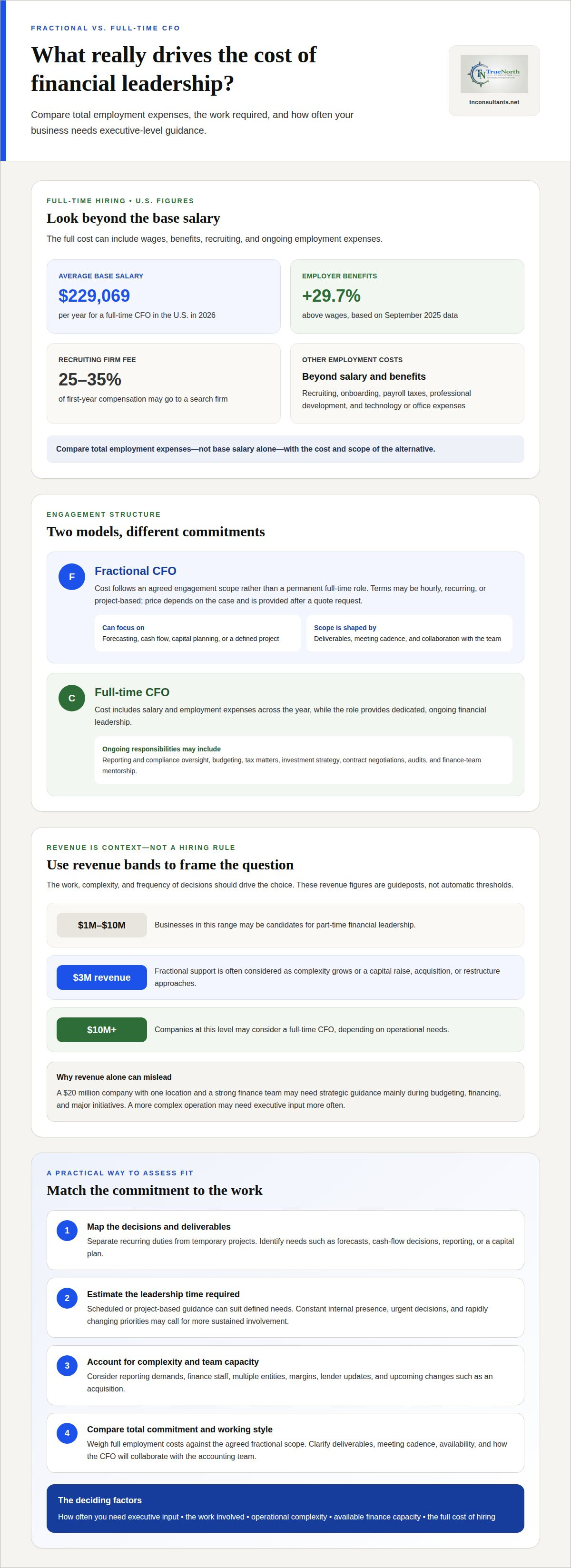
The average U.S. full-time CFO base salary is $229,069 per year in 2026. Employer benefits add roughly 29.7% above wages, based on September 2025 data. Hiring can also bring recruiting, onboarding, payroll taxes, professional development, and technology or office expenses. A search firm’s recruiting fee can reach 25-35% of first-year compensation.
CFO Pricing Models
Fractional engagements may use hourly, recurring, or project-based terms, with scope and involvement shaping the arrangement. The price depends on the case and is given after a quote request; expected deliverables, meeting cadence, and team collaboration help define the scope. Full-time hiring instead carries salary and employment costs across the year, whether strategic demands rise or fall. Compare the commitment with the financial work your business needs.
| Option | Cost basis | Access | Best fit |
|---|---|---|---|
| Fractional CFO | Agreed engagement scope | Scheduled or project-based guidance | Defined needs or changing demands |
| Full-time CFO | Dedicated executive role | Ongoing financial leadership |
Choose the model that fits how often you need executive input, the work involved, and the full cost of hiring.
Full-time CFO responsibilities
With a fractional CFO, access to executive guidance may be more limited between scheduled work periods. If urgent decisions arise or priorities change quickly, limited availability and less day-to-day integration can slow coordination. Clear responsibilities and regular communication help manage that risk.
A full-time CFO works exclusively for one company, providing ongoing financial leadership. In a larger firm, responsibilities may include investment strategy, contract negotiations, budgeting, tax matters, and regular audits. A CFO can also mentor a finance team and support consistent use of the company’s financial policies and procedures.
The role also includes financial reporting and compliance oversight. This may involve reporting under GAAP or IFRS standards and SEC filings for public companies. A CFO turns financial information into strategic decisions, helping executives assess cash needs, performance, and potential growth opportunities.
Consider a $6 million business with multiple entities, thin margins, and monthly lender updates. Daily executive involvement may suit its operating demands. A full-time CFO can coordinate reporting across entities, review margin pressures, and connect financial plans with decisions across the business. An acquisition can add further need for sustained leadership.
Fractional CFOs work with multiple companies at once, often supporting forecasting, cash flow, and strategic decisions. Their involvement can suit businesses that need expertise for specific priorities rather than a dedicated executive every day. A fractional arrangement is less suited to situations that require constant internal presence and rapid, ongoing direction.
A part-time CFO typically works for one company on a fixed, reduced schedule, often 10-20 hours per week. This differs from a fractional CFO serving multiple businesses, though both models provide less than full-time commitment. Part-time support can fit a company with recurring needs, such as scheduled forecasts, leadership reviews, and budget updates.
The distinction between a controller and a CFO also matters. A controller maintains the financial foundation, while a CFO uses financial information to guide forecasts, growth decisions, and long-term strategy. Map the decisions, reporting responsibilities, and leadership time your business needs before choosing a role.
What Does Each Option Really Cost?
A sound comparison connects financial leadership to the work your business needs done. Consider the scope, timing, and internal capacity involved in each option.
CFO Options by Cost and Scope
The fractional CFO vs. full-time CFO comparison should start with responsibilities, not titles. Fractional support can cover forecasting, cash flow decisions, or a defined initiative. Full-time leadership adds ongoing coordination across reporting, operations, and a finance team. List recurring duties separately from temporary projects, then assign an owner to each. This shows where executive judgment can add value.
Revenue Thresholds for CFO Hiring
Revenue can help frame the decision, but it isn’t a hiring rule. Businesses generating $1 million-$10 million may be candidates for part-time financial leadership, while companies with $10 million or more may consider a full-time CFO. Fractional support is often considered at $3 million in revenue, as complexity grows or a capital raise, acquisition, or restructure approaches.
The fractional CFO vs. full-time CFO choice also depends on how decisions move through the business. A $20 million company with one location and a strong finance team may need strategic guidance mainly during budgeting, financing, and major initiatives. Another company with more complex operations may need more frequent executive input.
Assess your growth stage by mapping upcoming decisions, reporting demands, and available finance staff. A business preparing for an acquisition may need focused analysis, while ongoing decisions across departments can call for sustained leadership. Revenue thresholds offer context, but the work itself should drive the commitment.
Before hiring, identify the financial questions that keep coming up and who currently answers them. Then determine whether the gap is strategic interpretation, coordination, or routine financial management. This review helps align the role with business needs instead of relying on revenue alone.
Fractional CFO engagement models
Fractional CFO work can be part-time, interim, or project-based. The right structure depends on whether your financial needs are recurring, tied to a transition, or focused on a defined objective. Set the scope around the decisions and deliverables your business needs.
A part-time CFO is typically embedded in one company on a reduced schedule, often 10-20 hours per week. This fixed schedule can support ongoing forecasting, reporting, and leadership meetings without a full-time commitment. It suits growing businesses with recurring financial work and a clear need for regular executive input.
An interim engagement addresses a temporary leadership need. For example, a business can bring in an interim CFO during a transition to maintain financial planning and decision support. Define the handoff, priorities, and expected involvement so the work stays focused as the business moves toward its next structure.
A project-based model centers on a specific goal, such as improving cash flow forecasting or preparing financial models for a capital raise. It can suit a complex initiative that needs dedicated financial analysis but not permanent CFO coverage. Set the project’s outputs and reporting approach at the start.
The level of involvement can also change as business needs shift. A company might begin with project work, then move to ongoing support as operations grow. Before agreeing on a model, clarify:
- Monthly deliverables and forecasting methods.
- Leadership meeting involvement and team collaboration.
- Onboarding steps and support for urgent decisions.
- How the scope adjusts when priorities change.
These details make each model easier to manage. They also show whether scheduled support can meet your needs or daily executive involvement matters more.
Define the work, schedule, and decision access your business requires, then discuss a CFO engagement model aligned with those priorities.
True North Consulting: Fractional CFO services
True North Consulting provides fractional CFO services for businesses that need strategic financial guidance without a full-time CFO role. Consider this support when forecasts need clearer direction, cash flow requires closer attention, or leadership is weighing a major business decision.
Financial leadership works best alongside reliable accounting information. True North Consulting also provides accounting and tax services, helping businesses connect day-to-day financial records with planning and compliance needs. Cannabis businesses can access specialized accounting tailored to their regulatory, compliance, and IRC 280E requirements.
The right next step depends on the decisions you need support with and how financial leadership should fit your operations. Contact True North Consulting to discuss your business’s needs.
Turn the Decision Into a Working Plan
The fractional CFO vs. full-time CFO decision becomes clearer when you define what financial leadership needs to own next. Start with a brief operating outline: the decisions requiring executive input, the information they depend on, and who will prepare and maintain it. Then identify how often leaders need guidance and what must happen between meetings. This turns a broad hiring question into a practical role design.
Use that outline to align the finance role with company priorities, internal capacity, and near-term plans. Note where responsibilities sit today and where decision-making slows down. If priorities shift, revisit the arrangement instead of letting an outdated structure dictate how financial work gets done. Clear ownership gives executives better context and keeps planning connected to operations.
A grounded discussion can help turn those requirements into a workable next step. Contact True North Consulting to talk through your business’s financial leadership needs and the support that may fit them. A clear plan can make the next stage of growth easier to manage.
Frequently Asked Questions
What is a fractional CFO?
A fractional CFO provides senior financial leadership without joining a business as a full-time executive. The engagement may focus on a defined project or recurring priorities. For example, an owner might work with a fractional CFO to build cash flow scenarios before expanding, then review the forecast as conditions change. This adds decision support while the business retains its existing accounting processes.
What is a Full-Time CFO?
A full-time CFO is dedicated to one company’s financial direction and internal coordination. They can connect finance with sales, operations, and leadership so teams work from aligned assumptions. For example, before approving a new product line, the CFO can bring operating costs, expected revenue, and funding needs into a single decision process.
Final Recommendation: Which CFO Is Right for You?
Choose based on how financial leadership fits your company’s actual workload. If decisions cluster around planning cycles or specific initiatives, a flexible engagement may fit. If finance must guide daily decisions across departments, a dedicated role may make more sense. For a Virginia business, map current priorities, internal capacity, and upcoming decisions before choosing a structure.
What Does a CFO Actually Do?
A CFO turns financial information into choices leaders can act on. This can include comparing budgets with actual results, building scenarios for a planned expansion, and identifying the assumptions behind a forecast. The role also helps executives see how hiring, pricing, or inventory decisions affect available cash, so operating plans reflect financial constraints and goals.
What is a Part-Time CFO?
A part-time CFO works with one company on a regular, reduced schedule. This suits businesses that need recurring executive input but don’t require someone in the role full-time. For example, a CFO might attend scheduled planning meetings, review monthly performance, and help prepare updated projections, while existing staff handles routine accounting tasks.
Which One Does Your Business Actually Need?
Your business needs the model that supports its decisions without leaving important work unmanaged. Start by listing the financial questions leaders face repeatedly, then identify who prepares reliable information and who interprets it. If the gap is strategic judgment, CFO support may help. If records and reconciliations are incomplete, strengthen that foundation before expecting forecasts to guide decisions.