


Budgeting matters before a business reaches a particular size. The right time for fractional CFO budgeting is when leaders need a clearer view of cash, costs, and the trade-offs behind growth decisions, not when they hit a fixed revenue or headcount threshold.
It’s reasonable to think of a budget as an annual exercise. In practice, a useful budget connects business goals to spending decisions, while forecasts help leaders adapt as revenue, costs, and plans change. A fractional CFO can bring those pieces together without making the process more complicated than the business needs.
This article explains when budgeting and forecasting become important, how a fractional CFO can shape an annual budget and rolling forecasts, and how variance analysis helps explain missed projections. You’ll also learn how financial tracking and regular reviews make planning more useful, and when fractional CFO support can help interpret the numbers and act on them.
Key Takeaways
- Use cash flow forecasts to spot potential shortfalls and understand how current plans may affect available cash.
- Compare actual results with projections to identify what drove a variance and inform the next forecast.
- Build an annual operating budget around business goals, resources, and priorities, while protecting areas that support quality and growth.
- Consider fractional CFO support when you need stronger financial tracking and planning without adding a full-time finance leader.
How can a fractional CFO help with budgeting and forecasting?
Budgeting matters when leaders need to connect business goals to spending and cash decisions. A fractional CFO can assess financial health, set objectives with management, and turn financial records into forecasts that guide action.
Cash Flow and 90-Day Forecasts
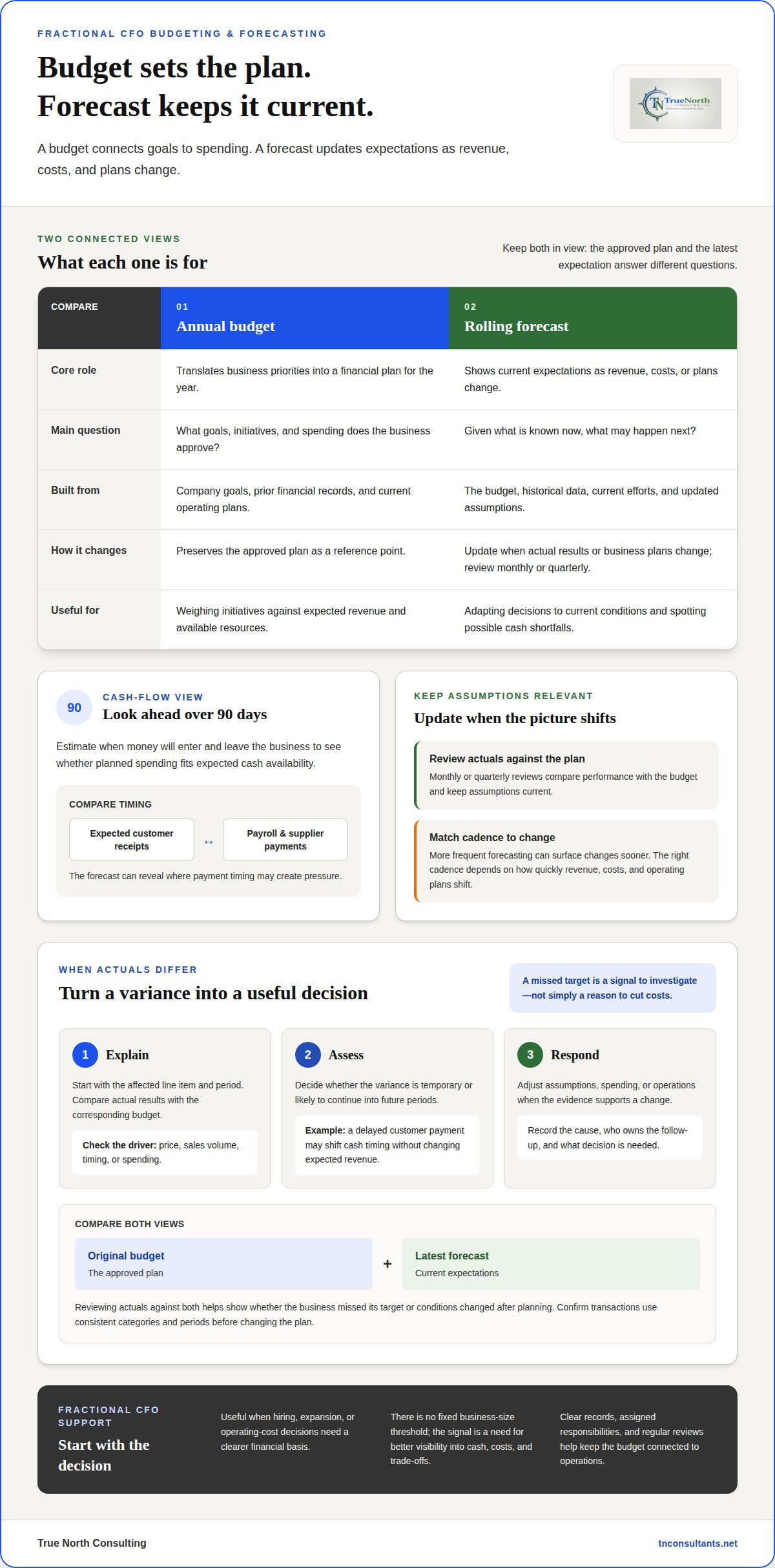
Cash flow forecasting estimates when money will enter and leave the business. It helps leaders spot potential shortfalls early and assess whether planned spending fits expected cash availability.
A fractional CFO can build 90-day forecasts from the company budget, historical data, and current efforts. For example, expected customer receipts can be compared with upcoming payroll and supplier payments. The forecast can then show where timing may create pressure.
To build a budget, a CFO needs prior financial records and a clear picture of the company’s current position. Reliable accounting records make the resulting forecast more useful.
Budgeting and Forecasting Support
Fractional CFO budgeting translates business goals into financial objectives and spending plans. Support can include reviewing financial health, setting short-term and long-term objectives, and identifying where to invest or pull back.
Start when decisions about hiring, expansion, or operating costs need a clearer financial basis. There’s no fixed business size: the signal is that leaders need better visibility into cash, costs, and trade-offs.
Choose a fractional CFO whose experience fits your business needs, decision priorities, and reporting expectations. Before work begins, agree on goals, responsibilities, and how progress will be reviewed.
The cost depends on the engagement and is provided after a quote request. Scope, business complexity, and the level of support needed shape the cost.
Outsourcing can create gaps if leaders don’t share accurate records or stay involved in decisions. Clear access, assigned responsibilities, and regular reviews help keep the budget connected to operations.
Tools and Forecast Updates
Budgeting tools organize assumptions, planned spending, and actual results. A fractional CFO may use spreadsheets, accounting systems, and planning models to connect financial records with business decisions.
Update forecasts when actual results or business plans change. Monthly or quarterly reviews can compare performance with the budget and keep assumptions relevant.
More frequent forecasting can help reduce variances by surfacing changes sooner. The right review cadence depends on how quickly revenue, costs, and operating plans shift.
Variance analysis and missed projections
Variance analysis compares actual financial results with budget projections, then identifies the cause of any difference. A missed revenue target or higher-than-planned expense is a signal to investigate, not simply a reason to cut costs. The cause may be timing, a changed business condition, or an assumption that no longer reflects operations.
Start with the affected line item and period. Compare actual results with the corresponding budget, then ask whether the variance came from price, sales volume, timing, or spending. If sales revenue falls below plan, for example, separate fewer customer orders from lower average order values. Each cause calls for a different response.
Next, determine whether the variance is temporary or likely to continue. A delayed customer payment may shift cash timing without changing expected revenue. A sustained drop in orders may require a revised sales outlook and spending plan. Record the cause, who owns the follow-up, and what decision is needed so the review leads to action.
Monthly or quarterly reviews can reveal patterns before they affect several reporting periods. Compare actuals against both the original budget and the latest forecast. The budget preserves the approved plan; the forecast reflects current expectations. Keeping both views helps leaders see whether the business missed its target or conditions changed after planning.
- Explain: Identify the underlying driver, not just the size or direction of the gap.
- Assess: Decide whether it affects future periods or only the current one.
- Respond: Adjust assumptions, spending, or operations when evidence supports a change.
Accounting quality matters because incomplete or misclassified transactions can distort comparisons. Confirm that actual results use consistent categories and periods before changing the plan. A focused budget variance analysis can help leaders connect financial differences to practical decisions and updated projections.
Annual operating budget creation
An annual operating budget translates business priorities into a financial plan for the year. Harvard Business School identifies resource availability, initiative prioritization, goal setting and reporting, financing, and planning for pivots as reasons annual budgeting matters. A budget gives leaders a structured way to weigh those demands against expected revenue and available resources.
Begin with the company’s goals, then connect each major initiative to its expected costs and financial contribution. A planned expansion, for example, may require additional staffing, equipment, and marketing. Show these costs separately so leadership can understand the resources involved and assess whether projected revenue supports the plan.
Build estimates from prior financial records and current operating plans. Review revenue assumptions alongside recurring costs such as payroll, rent, software, and supplier expenses. Note what has changed since the prior year: a new contract may affect expected sales, while a staffing plan can change labor costs. Clear assumptions make the budget easier to interpret and revise.
Prioritize spending before making cuts. Target inefficiencies without weakening quality, productivity, or strategic growth areas. For instance, review a process that consumes staff time before cutting resources tied to customer service or a key initiative. Compare each proposed change with the goals it supports.
Assign a responsible owner to each major budget area. Department leads can explain planned expenses and flag operational changes that affect projections. A finance lead can consolidate those inputs, check for omissions, and present trade-offs for leadership decisions. This connects departmental plans to one company-wide view.
Once leadership approves the annual plan, use it as a reference point throughout the year. Keep the original budget distinct from updated forecasts: the budget records the approved plan, while a forecast reflects current expectations. That distinction helps leaders explain changes without losing sight of their original commitments. It also makes annual planning useful in day-to-day decisions, rather than limiting the budget to the approval process.
Benefits of fractional CFO services
Fractional CFO support can strengthen financial decision-making without requiring a full-time executive role. Its value lies in clearer data, useful performance measures, and analysis tied to actual business choices. Leaders, for example, can use reporting to see whether a new initiative is meeting its operating goals.
Better data collection is one practical benefit. A fractional CFO can establish tracking systems to organize financial information and measure performance. When revenue, expenses, and operational measures appear together in regular reports, managers can identify which parts of the business need attention. The system also provides a more consistent foundation for future planning.
The level of support can also change over time. Once reporting and tracking systems are established, a business may engage a fractional CFO periodically or as needed. This can suit a company that needs financial guidance during planning or review periods but not ongoing executive-level input for every routine decision.
Another benefit is added finance capacity. A fractional CFO can bring in additional finance team members when needed to strengthen department capabilities. For instance, a company facing a reporting backlog may need extra support to organize its records before leadership reviews performance.
Compared with hiring a full-time CFO, fractional support can offer a different staffing model. Fractional fees depend on the engagement’s scope, reporting needs, and support frequency; pricing is provided after a quote request.
The model still requires internal involvement. Leaders need to share timely information, explain operational changes, and make decisions based on the analysis. Without those inputs, even well-designed tracking can miss important context. Define which decisions the finance lead supports and what information internal owners will provide.
For fractional CFO budgeting, the practical takeaway is to match support to the work ahead. If your business needs better financial tracking or periodic strategic input, discuss your budgeting needs.
True North Consulting: Fractional CFO services
True North Consulting helps businesses connect financial information with budgeting and planning decisions. Its fractional CFO services can support annual budgets, forecasts, and reviews of actual results against projections. This support can be useful when leaders need clearer financial visibility or a more consistent planning process.
Accounting services can help maintain the financial records that inform those decisions, while tax services address tax-related needs. For cannabis businesses, specialized accounting is tailored to unique regulatory, compliance, and IRC 280E requirements. Accurate, relevant financial information gives leadership a stronger basis for evaluating plans and operating choices.
Contact True North Consulting to discuss your budgeting and forecasting needs.
Put financial planning to work
Make the next planning cycle useful by tying financial decisions to clear ownership. Decide who will provide operating information, who will review assumptions, and who can approve changes. This keeps the numbers connected to the people responsible for acting on them.
Use fractional CFO budgeting as a decision framework, not just a document. Before committing to a major expense, define what the business expects it to achieve and what evidence would prompt a rethink. That discipline helps leaders make deliberate choices as circumstances shift.
Start with the decision that needs the clearest financial view. It may be a hiring plan, a new initiative, or a change in spending priorities. A focused conversation can clarify what information and financial support will help move that decision forward.
Contact True North Consulting to discuss your next budgeting step. A clearer process can help you move ahead with greater purpose.
Frequently Asked Questions
At what business size do budgeting and forecasting become important?
Budgeting and forecasting matter when decisions about spending, hiring, or growth depend on understanding available cash and expected results. There’s no single revenue or employee threshold. A small Virginia business planning its first major hire, for example, can map the role’s cost against expected sales and other commitments. The need grows with decision complexity, not simply company size.
At what size does it make sense to bring in outside help?
Outside financial support can make sense when leaders need analysis their current accounting process doesn’t provide. A growing company might have accurate transaction records but lack a clear view of how a new location could affect cash and operating capacity. Consider the decisions ahead, the reliability of internal reporting, and whether leadership has time to turn financial information into usable plans.
What are a startup’s main issues when it comes to budgeting and forecasting?
Startups often have limited operating history, so estimates rely more on assumptions than established trends. Customer demand, sales timing, and the cost of delivering a product can all shift. Lack of product-market fit is identified as a leading reason startups fail. A useful plan makes assumptions visible, separates known commitments from estimates, and updates expectations as customer activity provides new evidence.
What does a fractional CFO do in budgeting?
A fractional CFO connects financial planning with management decisions. For example, they can help leaders assess whether a proposed hire fits projected revenue, identify which assumptions drive spending plans, and define the financial measures to monitor. They can also establish a reporting approach so business owners can see how operating choices affect performance, rather than treating the budget as a standalone document.
How does a fractional CFO create an annual budget?
A fractional CFO works with leaders to align the budget with business priorities and available resources. The process can include reviewing financial records, gathering operating plans, and clarifying the assumptions behind expected revenue and expenses. For example, a department’s hiring request should connect to a business objective and its expected costs. Leaders can then compare competing priorities before approving the plan.
How can a fractional CFO help with cash flow planning and scenario analysis?
A fractional CFO can map expected cash receipts and payments, then examine how changes might affect the business. For example, a scenario could consider slower customer payments alongside planned supplier expenses. Comparing that case with the expected plan helps leaders see where timing creates pressure and which commitments may need attention. Revisiting assumptions regularly keeps the analysis relevant as actual sales and expenses emerge.