


For most federal decisions affecting a 2026 return, complete year-end moves by December 31, 2026, and account for Virginia state and local obligations based on where your business operates.
Entity structure, accounting methods, and the timing of key decisions all shape business tax planning, including how you prepare for tax obligations and pursue business goals.
A practical plan connects those decisions to your financial records and business priorities. Use the steps below to organize your choices and identify when tailored professional guidance could help.
Key Takeaways
- Mark the year-end cutoff for federal tax moves, and account for Oregon local estimated-payment timing when planning your calendar.
- Review your business structure as profits and operations change; an S corporation election affects payroll and how income is taxed.
- With accrual accounting, income and expenses follow when they are earned or incurred, so timing decisions depend on your records and accounting method.
- Treat individual tax moves as part of a year-round plan that connects tax decisions with cash flow and business goals.
1. When is the deadline for year-end small-business tax planning in Oregon?
For most federal decisions affecting a 2026 return, complete year-end moves by December 31, 2026. Virginia businesses should also account for state and local obligations based on where they operate. Federal estimated tax payments are made during the year, and the fourth-quarter payment is generally due January 15. Put those dates on your calendar separately from return filing deadlines.
Federal tax rates depend on your business structure. C corporations face a 21% federal corporate income tax rate; pass-through owners report business income through their individual tax returns. Estimated payments should be recalculated quarterly when income changes. For Virginia obligations, consider the business’s activity, structure, and operating locations when organizing payment and filing dates.
Business expenses generally need to be ordinary and necessary for the business. Operating costs, employee benefits, travel, and interest may qualify as deductions. For vehicles, meals, and home offices, retain receipts and records showing the business purpose and how expenses were calculated. The temporary 100% meal-expense deduction during the COVID-19 pandemic expired after 2 years.
Retirement contributions and eligible credits may also affect your year-end decisions. For 2025, the employee contribution limit for a Solo 401(k) is up to $23,500, with an additional $7,500 catch-up contribution for eligible people age 50 or older, according to the Internal Revenue Service. Eligible employers may claim a retirement plan startup-cost tax credit of up to $5,000 for three years. Qualified research credits may offset certain payroll tax liabilities.
Consider hiring a tax professional when you face an entity change, complex deductions, or incomplete records. Fees depend on the work’s scope and record condition; a quote follows a request. Keep invoices, receipts, payroll records, contribution confirmations, and calculations together. These records help support deductions, tax credits, and accurate returns, and give you organized documentation if the IRS asks questions.
Account for state and local obligations wherever your business operates. Your activities, business structure, and locations all affect which payments and filings belong in your plan.
2. Business entity selection and S corporation elections
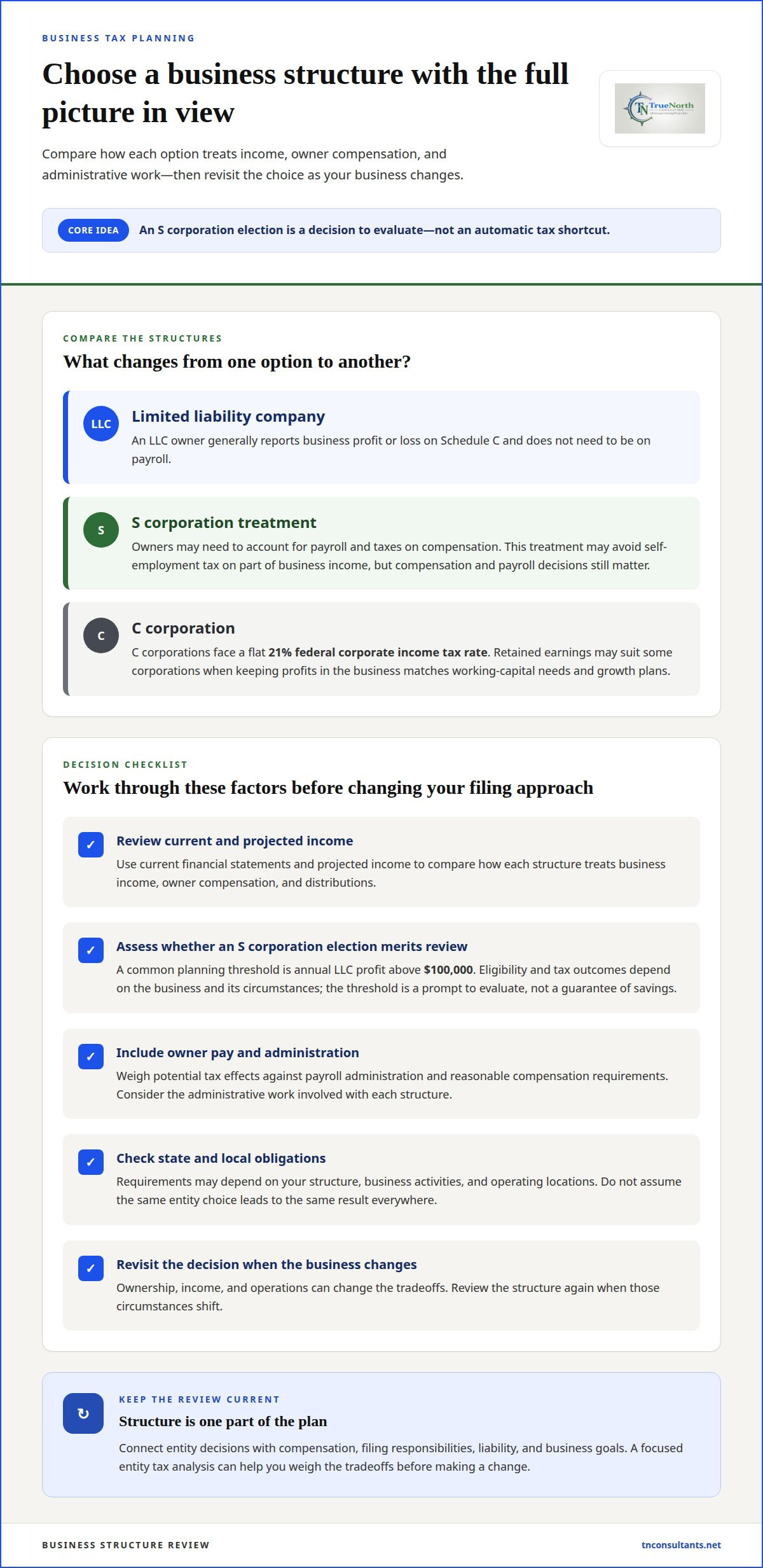
Your entity affects how income is taxed, how owners are paid, and which returns are required. An LLC owner generally reports business profit or loss on Schedule C and doesn’t need to be on payroll. S corporation owners may need to account for payroll and taxes on compensation. S corporation treatment may avoid self-employment tax on part of business income, but compensation and payroll decisions still matter.
Consider an S corporation election as profits grow, not as an automatic tax shortcut. A common planning threshold is annual LLC profit above $100,000, but eligibility and tax outcomes depend on the business and its circumstances. Compare potential tax savings with payroll administration, reasonable compensation, and the owner’s overall tax position. Revisit the choice when ownership, income, or operations change.
C corporations face a flat federal corporate income tax rate of 21%. Retained earnings strategies may suit some corporations, but keeping profits in the business should match working-capital needs and growth plans. Compare how each structure treats business income, owner compensation, and distributions before changing your filing approach.
Consider state and local obligations alongside federal tax treatment. Requirements may depend on your structure, business activities, and operating locations. Compare those obligations rather than assuming one entity choice leads to the same result everywhere. Also weigh liability and the administrative work each structure involves.
Review the tradeoffs using current financial statements and projected income. A focused entity tax analysis can help you weigh structure, compensation, tax treatment, and filing responsibilities before making a change.
3. Can I defer income or expenses if I use accrual accounting?
Accrual accounting records income when earned and expenses when incurred, not when cash changes hands. That timing can affect taxable income, but delaying an invoice doesn’t automatically defer income already earned. Paying early likewise doesn’t automatically make an expense deductible sooner. Before changing timing, review contracts, delivery dates, invoices, and accounting records. For accrual businesses, a bad debt deduction may apply when previously recorded revenue becomes uncollectible.
Business structure also affects deductions. The Internal Revenue Service says eligible pass-through business owners may deduct up to 20% of qualified business income. For 2025, the qualified business income deduction threshold is $197,300 for non-joint filers and $394,600 for joint filers. Compare ownership structure, income, and employee-related limits when evaluating the deduction. An entity change may alter how income flows to owners, so model its effects before making an election.
Equipment purchases require a separate timing review. For 2025, the Section 179 expense limit for qualifying property is $2.5 million, reduced when total qualifying purchase costs exceed $4 million, according to the Internal Revenue Service. A purchase should serve the business, not just create tax deductions. Consider when equipment will be placed in service, its cash impact, and whether the deduction fits projected income.
Self-employed owners should assess health coverage and HSA contributions as separate planning questions. For 2025, HSA contribution limits are $4,300 for self-only coverage and $8,550 for family coverage, with an additional $1,000 catch-up for people age 55 or older. Confirm eligibility and coordinate contributions with other coverage. Employees may have different plan options, so include benefits in compensation decisions.
Charitable gifts also need careful classification. Beginning in 2026, itemizers may deduct only charitable gifts above 0.5% of adjusted gross income. That rule concerns individual deductions, so business owners should distinguish personal gifts from business expenses. Track the recipient, payment, and purpose. A tax professional can assess how income timing, entity choice, and available deductions fit together before year-end.
4. Business tax planning versus tax strategies
A tax strategy is a specific action; business tax planning connects actions to your goals, cash position, accounting records, and filing obligations. Buying equipment is a strategy. Reviewing its timing, business need, and tax effect alongside projected income is planning. Confusing the two can lead to a deduction that strains cash or distracts from a better business decision.
A year-round review gives each tax decision context. Start with current financial statements and update income and expense forecasts as results change. Before a major purchase, compare its expected tax treatment with its operational value and cash demands. Before changing compensation or benefits, assess the effects on employees and owners. This connects federal obligations with your company’s priorities.
Every tax strategy has limits. Tax-loss harvesting, for example, means selling an investment at a loss to offset gains. That may serve a tax purpose, but the investment decision should still fit your broader financial goals. Tax incentives also have eligibility rules and documentation requirements. When considering an incentive, record the business purpose, transaction date, and supporting financial documents.
Use accounting as an early-warning tool, not just a filing task. Monthly reports can reveal changes in revenue, expenses, or available cash before year-end. An advisor can help assess whether a strategy fits the current facts. A retirement plan decision, for example, should account for employee participation, contribution timing, and the company’s ability to fund it. Make a deliberate choice, not a last-minute tax move.
Consult an advisor when a significant purchase, ownership change, new incentive, or shifting income creates tax questions. Bring current financial statements and a clear description of the planned decision. A practical review should explain the tax effect, required records, and tradeoffs in plain language. That turns business tax planning into an ongoing decision process rather than a list of isolated tactics. Discuss your accounting and tax decisions with a professional advisor.
True North Consulting
True North Consulting connects tax decisions with accounting records, cash flow, and business priorities. Its accounting and tax services support year-end preparation, deduction and entity reviews, and clear financial documentation. Fractional CFO services help you weigh tax decisions against their effects on operations and growth. For cannabis businesses, specialized accounting addresses industry-specific financial and compliance needs.
Consider support when entity choices, changing income, or incomplete records make your options harder to assess. True North Consulting can organize financial information and help prepare for tax obligations, so decisions reflect how your business operates.
Contact True North Consulting to discuss your business tax planning needs.
Make your next tax decision with a clear plan
Turn tax questions into decisions with a clear purpose. Before your next planning conversation, identify the choice ahead, the business goal behind it, and the financial records that can inform it. This keeps business tax planning connected to operations instead of treating tax as a year-end task.
True North Consulting brings accounting, tax, and financial leadership perspectives to business decisions. Start with a planned investment, a change in ownership, or questions about how your records support a tax position. The aim is practical clarity: understand the tradeoffs, identify the relevant information, and choose a workable next step.
Bring your current question and the relevant financial documentation to the conversation. Contact True North Consulting to discuss your next tax decision. A clear starting point can help you move forward with more confidence.
Frequently Asked Questions
When is the deadline for year-end small-business tax planning in Oregon?
There’s no single deadline for every planning decision. The right cutoff depends on the action, its eligibility requirements, and the records needed to support it. Set an internal review date early enough to assess decisions and gather documentation. Keep separate calendars for tax filings, payments, payroll forms, and benefit contributions. In Virginia, state and local obligations depend on business activity and location.
Can I defer income or expenses if I use accrual accounting?
Match any proposed timing change to the contract, invoice, delivery, and supporting records. For example, review a December service agreement and a January customer payment alongside the work performed and accounting entries. Document the reason for adjustments, and ensure each transaction appears consistently in the general ledger and supporting schedules.
How Can Small Businesses Help Mitigate Their Taxes?
Make review repeatable by keeping books clean, accounts reconciled, and business and personal activity separate. A retailer, for example, can compare inventory records with purchases and sales before preparing financial reports. Consider owner compensation, employee benefits, and planned investments as connected business decisions. Organized records make tax considerations easier to identify without relying on estimates or unsupported categories.
Should I defer income to the next year to lower my taxes?
Not necessarily. Deferring income may shift tax pressure into a year with higher income, lower cash reserves, or a major planned purchase. Before changing a contract or collection schedule, consider customer terms, business needs, and the next year’s forecast. Base the decision on a genuine commercial plan, not simply a desire to move a tax item between periods.
Tax deductions and tax credits: What’s the difference?
A deduction reduces the income used to calculate tax; a credit is applied against the tax bill. To compare potential benefits, first confirm each item’s eligibility rules and supporting documentation requirements. A large deduction and a credit aren’t equivalent dollar amounts. Keep separate workpapers for each claim so the reasoning and records are clear.
What are the risks?
Tax decisions can cause problems when accounting treatment, business records, and the filed return don’t align. A weak paper trail can make a tax position difficult to support, while an unsuitable strategy can reduce cash available for operations. Keep source documents, reconcile related accounts, and record the business purpose of unusual transactions. Review significant changes before filing instead of trying to reconstruct them afterward.