


State tax relief doesn’t remove the federal restriction: in cannabis tax planning, the key distinction is that businesses trafficking in Schedule I or II controlled substances generally can’t deduct business expenses or claim credits under Internal Revenue Code § 280E, except for cost of goods sold, according to the U.S. Congress.
State treatment can differ: as of Jan 2026, 24 states and jurisdictions allow cannabis businesses to deduct business expenses at the state level. So even if your state permits deductions, you still need to account for the federal limit and keep inventory costs separate from operating expenses.
This guide explains how § 280E affects deductible expenses, how inventory accounting shapes cost of goods sold, and why state rules can change your tax picture. You’ll also learn what potential federal rescheduling could mean for tax treatment, so you can make decisions based on the rules that apply rather than assuming state legality settles the federal question.
Key Takeaways
- Separate cost of goods sold from operating expenses, and understand why the distinction matters under Section 280E.
- Build inventory accounting around clear records of product purchases and production costs.
- Assess state tax treatment separately from federal rules; state-allowed deductions don’t automatically change federal treatment.
- Track rescheduling developments and keep financial documentation organized so your tax decisions reflect applicable rules.
What expenses can a cannabis business deduct under 280E?
Section 280E limits federal deductions for cannabis businesses covered by the statute. The key distinction is between cost of goods sold and ordinary operating expenses.
Federal Treatment Under Section 280E
Section 280E restricts federal tax deductions for businesses trafficking in controlled substances covered by the statute. Under Internal Revenue Code § 280E, businesses trafficking in Schedule I or II controlled substances generally cannot deduct business expenses or claim credits, except for cost of goods sold, according to U.S. Congress (U.S. Code). For your business, that distinction affects how expenses are classified and how much income remains taxable for federal purposes.
Limits on Cannabis Business Deductions
Section 280E limits deductions for operating expenses, even when those expenses support a cannabis business. Rent, payroll, and utilities may be necessary to operate, but necessity alone does not make them deductible under the federal rule. The practical effect is that taxable income may not reflect the business’s cash profit. Keep expense categories distinct from inventory costs; combining them can weaken the accounting trail supporting your tax treatment.
Cannabis tax planning depends on the operation: cultivators, manufacturers, and retailers have different purchases, production activities, and inventory flows. A key task is distinguishing costs tied to goods sold from costs that support general operations. For example, a retailer’s store rent supports the business, while product acquisition relates to inventory. Accurate records help document these distinctions without treating every business expense as cost of goods sold.
How does Section 280E affect cannabis business taxes? It generally prevents covered businesses from deducting ordinary expenses or claiming credits on federal returns, leaving cost of goods sold as the exception. That can make federal taxable income higher than cash profit suggests, so separate expense tracking matters for tax calculations and financial decisions.
State treatment can differ from federal treatment. As of Jan 2026, 24 states and jurisdictions allow cannabis businesses to deduct business expenses at the state level. Some states, including California for licensed businesses, have adopted some form of relief from the federal Section 280E limitation. State deductions do not change the federal rule; maintain separate federal and state calculations so each return reflects its applicable treatment.
Cost of Goods Sold and inventory accounting
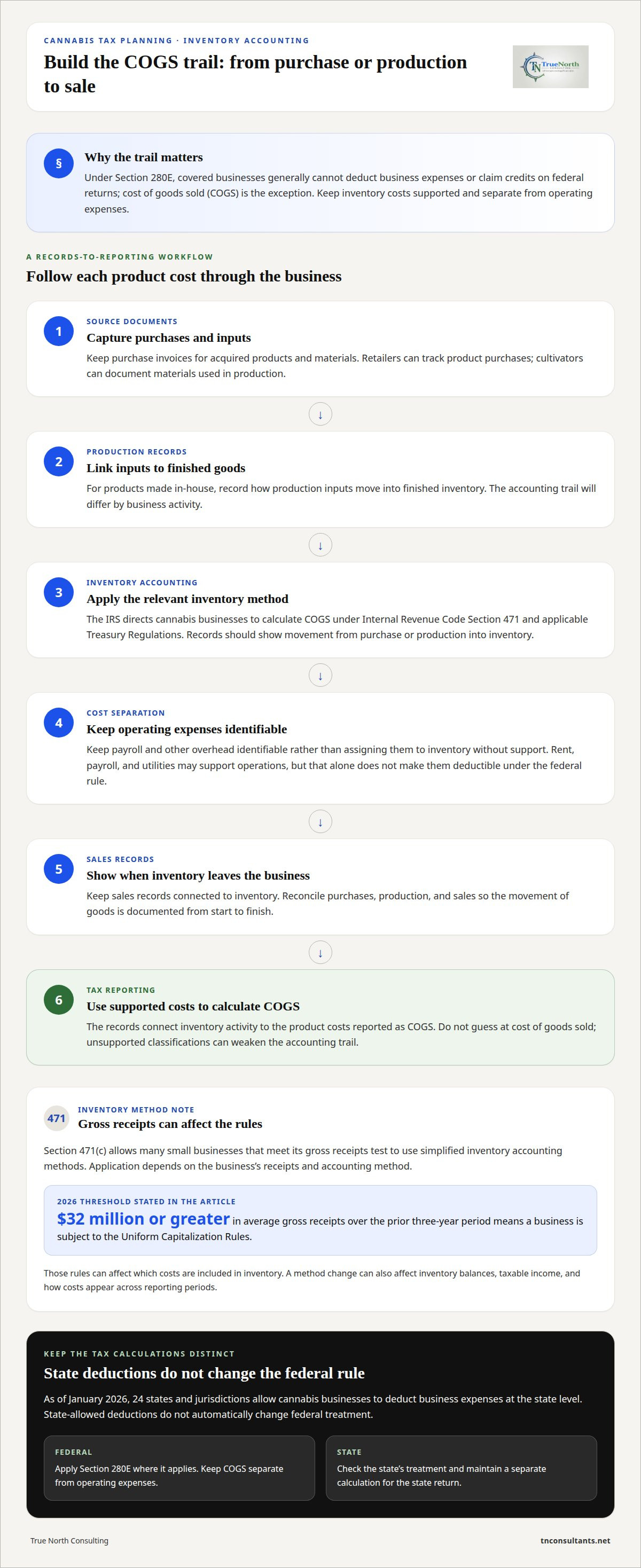
Cost of goods sold (COGS) connects inventory records to the product costs reported for tax purposes. Under Section 280E, accurate accounting matters because eligible inventory costs receive different treatment from disallowed operating expenses.
The IRS directs cannabis businesses to calculate COGS under Internal Revenue Code Section 471 and applicable Treasury Regulations. That means records should show how products move from purchase or production into inventory and, ultimately, sales. A retailer’s records may track product purchases and sales. A cultivator’s records may trace materials and production through finished inventory. Each structure creates a different accounting trail.
Keep source documents connected to each stage of the business. Purchase invoices support acquired products and materials, production records link inputs to finished goods, and sales records show when inventory leaves the business. Keep payroll and other overhead identifiable rather than assigning them to inventory without support. Do not guess at cost of goods sold.
Section 471(c) allows many small businesses meeting its gross receipts test to use simplified inventory accounting methods. The rule’s application depends on the business’s receipts and accounting method. For 2026, businesses with average gross receipts of $32 million or greater over the prior three-year period are subject to the Uniform Capitalization Rules. Those rules can affect which costs are included in inventory, so the business structure and activity matter.
Changing accounting methods requires planning. A method change can affect inventory balances, taxable income, and how costs appear across reporting periods. Before a transition, map the current method, inventory records, and proposed treatment; then identify the tax filings affected. IRS Chief Counsel Advice 201504011 addresses inventory costs, while SIRA Naturals’ 2022 Tax Court petition argued that costs disallowed under Section 280E could be capitalized under Section 471(c). The petition highlights why method choices need careful analysis, not assumptions.
Clear inventory management supports both tax calculations and operating decisions. If purchase, production, and sales records don’t reconcile, cannabis accounting support can help organize the accounting trail.
Does Section 280E apply if cannabis is legal in my state?
State authorization and federal tax treatment are separate questions. A state license does not, by itself, determine how federal rules apply to a marijuana business.
Federal Taxation of State-Sanctioned Sellers
Federal taxation concerns income from marijuana sales, even when state law authorizes the business. The IRS states in Publication 525 that income from illegal activities, including drug sales, must be included in gross income. That means state permission does not make sales income disappear from federal tax reporting. Your taxable income calculation must also account for the federal rules that apply to the business.
State and Federal Regulatory Conflicts
State marijuana laws may permit licensed businesses to operate, while federal tax law applies its own standards. In practice, state compliance does not automatically provide federal tax relief. Keep state and federal calculations distinct, and document how each return treats income and expenses. For example, a deduction allowed on a state return may not receive the same treatment federally.
Section 280E Applicability
Section 280E applies to businesses trafficking in Schedule I or II controlled substances. The rule can reach a state-authorized marijuana seller because state licensing does not itself change the federal classification or tax provision. Its effect depends on the business activity and the applicable federal rules, not solely on whether the state permits sales.
Filing obligations also depend on business structure. Sole proprietors generally report cannabis business income on Schedule C (Form 1040). Cannabis businesses should make required estimated tax payments and pay employment taxes on time. The applicable return and filing schedule follow the entity’s tax status and filing requirements.
Potential Effects of Federal Rescheduling
Rescheduling could affect the federal tax analysis, but a proposal alone does not change tax treatment. In June 2024, the IRS stated that proposed cannabis rescheduling would not mitigate Section 280E until a final rule was issued, and that Section 280E refund claims were not valid. For planning, distinguish a proposed change from an effective federal action. Keep records that support current filings and make any future adjustments based on the rules then in effect.
What happens if cannabis is rescheduled federally?
Federal rescheduling could change cannabis businesses’ tax treatment, but it would not automatically resolve every filing question. The effect would depend on the final federal action and each business’s tax position.
Rescheduling and Tax Compliance
Rescheduling changes cannabis’s classification under federal controlled-substance rules and may affect how Section 280E applies. The IRS has stated that cannabis scheduling has not changed and that refunds for previous years under IRC § 280E are not currently available. Treat proposed changes and effective federal rules as distinct when preparing tax filings. That keeps current decisions grounded in the applicable treatment rather than an assumed future outcome.
Inventory Costing and Multistate Compliance
For a business operating in multiple jurisdictions, account for the tax rules that apply in each one. Cannabis taxes may be based on price, weight, or THC potency, and a state may also impose sales, excise, cultivation, or local taxes. These structures affect pricing and cash flow differently. For example, a potency-based calculation differs from one based on a product’s sale price. Separate state tax schedules help show how each jurisdiction’s rules affect reported obligations.
Federal and state tax calculations may treat expenses differently. A state-level allowance does not automatically change the federal calculation. Reconcile each jurisdiction’s tax results to the same financial statements, while preserving the distinct adjustments used for each return. This makes differences easier to explain during planning and filing.
IRS Priorities and Compliance Risks
Tax compliance also includes timely employment tax payments and accurate reporting. Federal employment tax nonpayment can result in 100% personal liability penalties for responsible business officers. Build payroll tax payments into cash flow monitoring, and make sure reported wages reconcile with payroll records. These controls address a separate compliance exposure from rescheduling and help keep tax obligations visible throughout the year.
For support aligning cannabis tax reporting with business decisions, get cannabis accounting support.
True North Consulting: Cannabis accounting
True North Consulting provides specialized cannabis accounting for operators who need clear records and practical tax support. The firm can help connect inventory activity, cost of goods sold, and financial reporting, so you can see how accounting decisions affect operations and tax preparation.
Consider support when bookkeeping gaps make reporting difficult, inventory records need structure, or tax obligations are approaching. True North Consulting also provides ongoing accounting and financial reporting to help organize records around your business activity. The aim is financial information you can use to make decisions, not figures left unexplained in a report.
If you’re ready to discuss your cannabis business’s accounting needs, contact True North Consulting.
Build a Clear Path for Your Next Tax Decisions
Make planning a regular business practice, rather than reacting only to a filing deadline or a change in federal policy. Revisit business assumptions, tax positions, and financial priorities on a consistent basis. This gives you a clearer foundation for evaluating how new developments may affect operations and future decisions.
True North Consulting supports cannabis businesses with tax services, accounting services, and fractional CFO services. When your records and tax decisions need to support broader operational goals, cannabis tax planning can connect financial details with the direction of your business.
You don’t need to resolve every question before starting a conversation. Bring the issues affecting your decisions, and discuss a practical way forward with the team. Contact True North Consulting for tax guidance and take the next step with greater clarity.
Frequently Asked Questions
Are there states that allow more deductions despite 280E?
State and federal tax treatment can differ, so compare the rules and adjustments used on each return. A practical workpaper can list each state adjustment, its accounting category, and the supporting transaction records. This helps trace how the same business activity appears in separate calculations without assuming that treatment on one return automatically applies to another.
How do dispensaries pay federal taxes?
A dispensary’s federal filing approach depends on its tax classification and ownership structure. Keep business transactions separate from owner activity, and organize revenue, payroll, and operating records by the entity that earned or paid them. Clear records give the return preparer a stronger basis for reporting income and reconciling business activity to the appropriate filing.
What are the unique tax challenges and opportunities within the cannabis industry?
A key challenge is turning specialized financial records into information you can use to manage the business. Compare sales patterns with purchasing and payroll trends to identify changes in operations. This supports cash flow monitoring and profitability analysis, while cannabis tax planning connects operating insights with tax decisions and keeps bookkeeping useful throughout the year.
Why do state cannabis tax structures vary?
States take different approaches to regulating and taxing cannabis, based on their own policies and administrative systems. If your business operates in more than one jurisdiction, identify which rules apply to each location and transaction. Map sales activity to the relevant jurisdiction in your financial reporting, giving state-specific calculations a clear operational basis.
Will IRS or tax audits treat cannabis businesses differently?
An IRS review can examine whether return figures are supported and reported consistently. For an internal review, trace selected amounts on the return to ledger accounts and then to the records supporting those entries. This can reveal mismatches before filing, such as a reported total that differs from the underlying accounting records, and clarify how figures were assembled.
What expenses can cannabis businesses deduct or include in cost of goods sold?
Whether a cost is deductible or included in inventory depends on its business function and the accounting treatment that applies. A transaction label alone does not determine its tax treatment. Separate costs by purpose in your accounting records instead of grouping unrelated purchases under a broad expense category. This detail supports consistent classification in tax returns and financial reports.