


Cannabis tax preparation must account for Section 280E, which limits deductions for cannabis businesses and allows cost of goods sold as the only offset to cannabis income. That makes accurate inventory records, expense categorization, and tax documentation central to understanding taxable income and preparing a return.
Your business structure and records also shape how tax obligations are reported and how you support the figures in your filings. This article explains how 280E affects cannabis businesses, what preparation involves for cannabis and hemp operations, and how organized financial documentation can support tax reporting and audit readiness.
Key Takeaways
- Organize inventory, expense, and transaction records to support accurate tax reporting under Section 280E.
- Keep federal tax considerations separate from state and local filing and reporting requirements.
- Review how your business structure affects tax reporting before making changes to your operations.
- Maintain clear, traceable financial documentation so you can support reported figures if questions arise.
Accounting and advisory support for cannabis and hemp businesses
For a cannabis business anywhere in the United States, accounting should connect sales, purchases, and inventory movements to supporting records. In cultivation, production logs and labor records help explain how products move from seed to sale. In retail, point-of-sale reports, deposits, and inventory counts should reconcile with accounting records. This gives cannabis tax preparation a reliable starting point and makes monthly reporting more useful for operational decisions.
Section 280E limits deductions for cannabis businesses, with cost of goods sold as the only allowable offset to cannabis income. That makes cost accounting especially important. IRC 471-11 provides a basis for GAAP inventory accounting, including cost and absorption accounting, when calculating cannabis cost of goods sold. Keep records that explain assigned inventory costs and support reported figures. PKF O’Connor Davies notes that tax liability may differ substantially depending on whether a business uses cash or accrual accounting.
State-specific cannabis accounting and tax guidance can help businesses identify questions tied to their location and activities. Operators in Virginia, for example, should use guidance relevant to Virginia rather than defaulting to another state’s procedures. Build cannabis tax preparation around the business’s actual records, tax accounts, and operations. A retailer and a cultivator may need different approaches to tracing transactions and inventory activity.
Cannabis accounting training can help practitioners understand inventory costing, transaction categorization, and industry records. For operators, the practical test is whether bookkeeping captures transactions consistently and produces reports that explain revenue, costs, and inventory changes. Training should connect accounting concepts to cultivation or retail workflows. Hemp and CBD businesses also need records that reflect their products and operations; the 2018 Farm Bill is relevant to CBD businesses, but does not make every product or transaction identical for accounting purposes.
So What Does This Mean for Cannabis Businesses?
Federal, state, and local requirements can shape revenue reporting, records, and deductions. Cannabis businesses should organize tax and operating records around the jurisdictions where they conduct business.
State and Federal Compliance
Federal tax reporting and state licensing or tax records serve different purposes. Organize revenue and expenses by business activity, and retain licensing records alongside financial statements. For example, a Virginia retailer should be able to connect sales reports to its books while keeping licensing documentation distinct from tax support. These records help explain how the business operates and how it assembled its reported figures.
Regulatory Uncertainty
Federal, state, and local regulations can differ, creating separate compliance questions for cannabis companies operating across jurisdictions. PKF O’Connor Davies notes that regulatory inconsistencies across these levels make compliance difficult. The IRS has offered little guidance on which cannabis business expenses may be deducted. Document transaction classifications and the reasoning behind them so your accounting records show how the business treated its activity when preparing filings.
Cannabis Tax and Excise Issues
Section 280E limits deductions and federal credits available to cannabis businesses. State and local tax treatment also depends on the transaction and jurisdiction. For a Virginia operator, organize sales, inventory movements, and tax calculations by location and business activity. Keep supporting records for each reported amount, and distinguish taxable sales from other revenue in accounting reports. This makes it easier to see how federal tax treatment and state or local obligations affect operating decisions.
Build these distinctions into accounting procedures: reconcile sales reports to deposits, retain support for tax calculations, and keep records tied to the locations where business activity occurs. Organized records can also help owners assess how tax obligations affect available capital and routine cash-flow decisions.
Corporate structuring to minimize 280E impacts
An entity choice can affect how a cannabis business reports income and plans for taxes, but it doesn’t erase Section 280E. Review the structure alongside actual operations, ownership, and accounting records before changing how the business is organized.
280E Deduction Impacts
Section 280E limits deductions available to businesses that sell marijuana, making the distinction between deductible expenses and cost of goods sold consequential. Your accounting should show how each expense relates to the business and how inventory costs were calculated. Keep support for the treatment of costs, including the activities involved and the records used. That documentation helps explain the figures reported as income and cost of goods sold.
Do not treat an entity election as a substitute for accurate cost accounting. A structure may change how income is reported, but it does not make an unsupported expense an allowable deduction. Review the tax impact using the business’s actual books and operating model.
280E Planning and Compliance
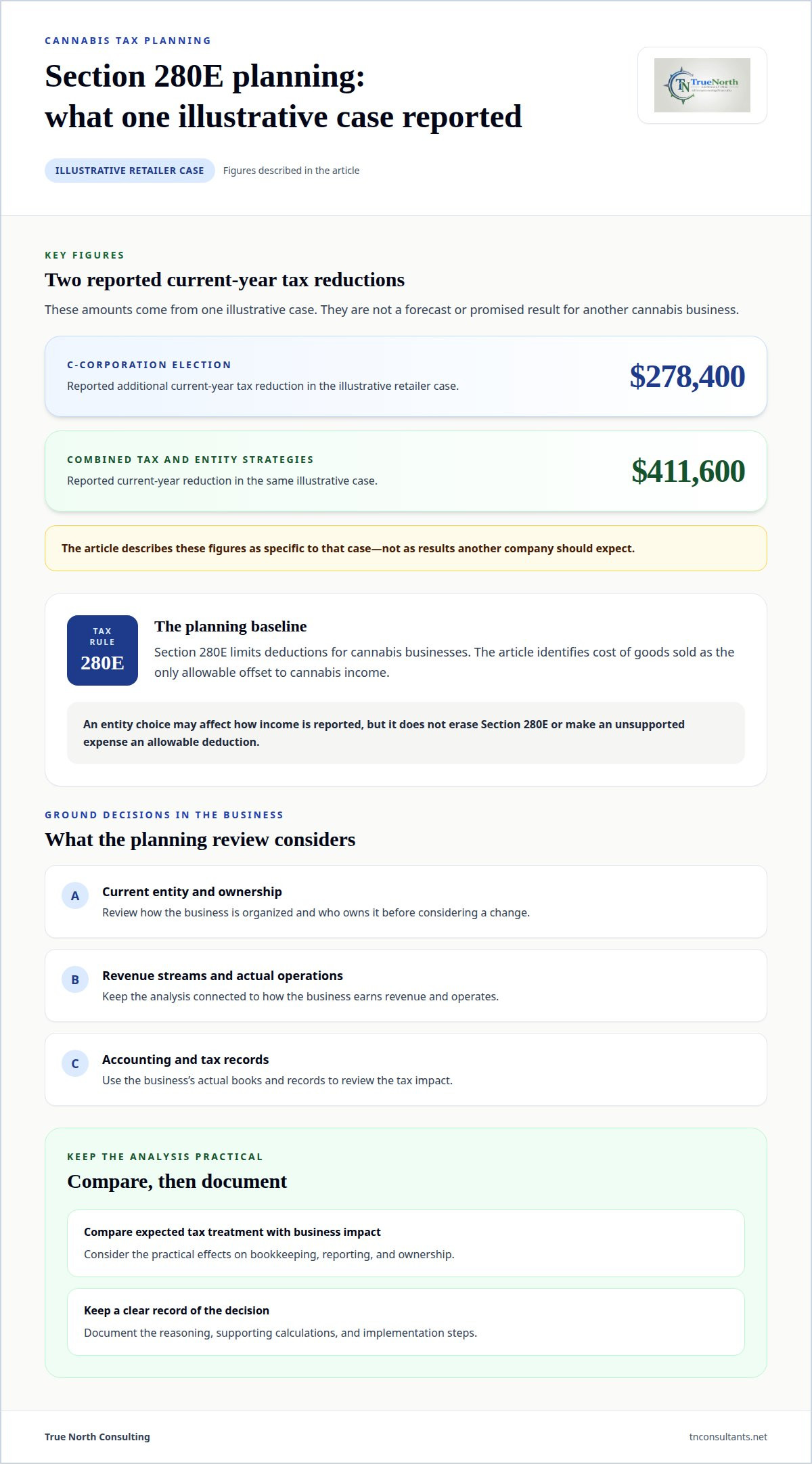
Section 280E planning starts with a review of the current entity, ownership, revenue streams, and accounting and tax records. An illustrative retailer case described a C-corporation election that produced an additional $278,400 current-year tax reduction. The example is specific to that case, not a promised result for another cannabis company. Entity decisions should account for both tax reporting and business operations.
In the same illustrative case, combined tax and entity strategies produced a $411,600 current-year reduction. Those figures show why planning requires scenario analysis, not a copied structure. Compare the expected tax treatment with the practical effects on bookkeeping, reporting, and ownership. Record the reasoning, supporting calculations, and implementation steps.
For IRS Section 280E planning, keep entity records aligned with the books and tax filings. Document changes in ownership or business activity, and maintain separate records for distinct revenue streams. This makes it easier to explain how the chosen entity reflects the business involved and how reported income was calculated.
Audit documentation and support
Audit readiness starts with records that connect reported amounts to business activity. Keep bank statements, sales reports, invoices, payroll records, inventory counts, and tax returns organized by accounting period. For a dispensary, reconcile point-of-sale totals with deposits and recorded revenue. For cultivation, retain production and inventory records that trace product movement from seed to sale. These links help owners explain how figures moved from operating systems into financial statements and tax filings.
Controls make records easier to follow. Document who approves purchases, records transactions, handles deposits, and reviews reconciliations. Keep dated support for adjustments, including the reason for each change and the records used. If a licensed business reports an excise tax amount, retain the transaction details and calculation behind it. A reviewer should be able to trace each figure from its source document to the accounting entry without relying on memory or informal explanations.
Cannabis businesses may face heightened audit scrutiny because of their income source and federal law. Consistent records are useful before an IRS inquiry arrives. A practical readiness process includes reconciling accounts, resolving unexplained inventory differences, and matching filed returns to final accounting records. Keep copies of correspondence and note the dates, records provided, and responses made during an examination.
If the IRS requests support, organize your response around each question rather than sending unrelated files. For example, group sales reports, deposit records, and ledger entries when explaining reported revenue. For cost classifications, include the calculation and supporting invoices or labor records. Review each response for completeness and consistency with filed returns. A clear audit trail helps you respond accurately and show how your accounting procedures operated during the period under review.
True North Consulting: Cannabis accounting
True North Consulting supports cannabis businesses with accounting and tax work shaped around their records, operations, and Section 280E considerations. Its cannabis accounting helps organize bookkeeping, cost of goods sold support, and financial reporting, giving you clearer information for tax obligations and business decisions.
Turn to True North Consulting when bookkeeping gaps, inconsistent reports, or disconnected inventory and accounting records make tax preparation harder to manage. Accounting services help organize financial documentation and improve monthly reporting. Tax services address preparation needs, while Fractional CFO services connect financial results with planning and operational priorities.
True North Consulting supports audit preparation by organizing financial records and seed-to-sale accounting trails. The firm does not provide audit and attestation services. If your cannabis business needs clearer accounting records or practical tax preparation support, contact True North Consulting to discuss your needs.
Make your next tax cycle more organized
Make your next planning conversation a chance to turn tax preparation into a repeatable business process. Decide who maintains operating records, how often the books are reviewed, and how unresolved differences reach the right decision-maker. This framework can connect daily activity with financial reporting and make future cannabis tax preparation more manageable.
True North Consulting provides accounting, tax, and Fractional CFO services for cannabis businesses. The team can help identify accounting priorities and connect financial information with operational decisions. A useful starting point may be reviewing records, discussing entity planning, or considering how financial reporting supports your goals.
Contact True North Consulting to discuss a practical next step for your business. Clear processes can help you move forward with greater confidence.
Frequently Asked Questions
What are the different types of cannabis taxes?
Cannabis businesses may encounter federal income taxes, state income or withholding taxes, sales taxes, and cannabis excise taxes. Which apply depends on the business’s activities and location. For example, a retailer may need to account for sales taxes on taxable sales, while a cultivator’s transfers may receive different tax treatment. In Virginia, organize tax records by business activity and the applicable filing jurisdiction.
What is each state's cannabis tax system for 2024?
States used different approaches in 2024, including sales taxes, excise taxes, and taxes based on weight or THC content. There is no single system that applies nationwide. For a Virginia business, identify the relevant tax accounts and filing obligations based on its activities and operating locations. Keep sales and transaction records organized to support the treatment applied in each filing period.
How does IRS Section 280E affect cannabis business taxes?
Section 280E limits deductions and federal credits available to cannabis businesses, so federal taxable income may differ from book profit. That distinction can affect cash planning because accounting profit alone may not show the amount subject to federal tax. The IRS also considers personal income earned by small-business owners in the cannabis industry, making clear separation between business and personal records useful.
What federal tax deductions can cannabis businesses claim under Section 280E?
Under Section 280E, cost of goods sold is the only allowable offset to cannabis income. The practical task is to distinguish supported inventory costs from other expenses and preserve records for the amounts included in cost of goods sold. An expense appearing in accounting software does not, by itself, establish that it can offset cannabis income for federal tax purposes.
How do cannabis businesses calculate cost of goods sold for tax purposes?
Calculate cost of goods sold from supported inventory costs using a consistent accounting method. IRC 471-11 provides a basis for GAAP inventory accounting, including cost and absorption accounting. Keep records that connect inventory amounts to business activity, and track employee time tied to inventory tasks when it supports labor-cost classification. Reconcile inventory records to accounting entries so reported costs have a traceable basis.
What federal and state tax forms do cannabis businesses need to file?
The required forms depend on the entity’s tax classification, business activities, and the jurisdictions where it operates. A Virginia business should identify its applicable federal and state filing accounts, then build a calendar around those obligations. Retail sales, employees, and the entity’s tax status can affect which returns or reports apply. Retain copies of filed forms alongside payment records and supporting reports.